Travel Scams and Fake Booking Sites: How to Spot and Avoid Them
The red flags of fake booking sites, a quick routine to verify any seller before paying, and the steps to take if you were scammed.
Fake travel booking sites look polished, rank in search ads and offer fares that seem just low enough to be believable. This guide shows you the red flags to spot, a short routine to verify any seller before you pay, and exactly what to do if you have already been caught.
Key takeaways
- Price alone is not proof of a scam, but a low price combined with pressure and an unusual payment method is a strong warning.
- Reach airlines and agencies by typing their address yourself, not through search ads, social media replies or links in messages.
- Pay by credit card where you can. Wire transfers, gift cards, payment apps and crypto are very hard to recover.
- A real ticket has a ticket number you can check with the airline itself before your trip.
- If you paid a scammer, contact your card issuer or bank the same day, then report it to the authority in your country.
How the common travel scams work
Most travel scams follow a few patterns. Knowing them makes the warning signs easier to see, even when the website or message looks professional.
The lookalike booking site
A site copies the design of a real airline or agency, or invents a brand with a convincing name. It takes your card details and payment, then sends a “confirmation” with no real ticket behind it, or a reservation that is later canceled.
The fake customer service number
The US Federal Trade Commission (FTC) warns that scammers buy paid search ads that pair their own phone number with a well-known company’s name. A stressed traveler searches for “airline rebooking number”, calls the top result and pays for a rebooking that never happens.
The social media “agent”
Complain about a delay in public and an account that looks like the airline may reply within minutes. The FTC describes scammers who impersonate airline customer service this way and then ask for booking references, phone numbers or bank details.
The phishing email or text
A message says your flight was canceled or your payment failed, and links to a page that asks you to “confirm” your card. The link leads to a copy of the real site built to collect your details.
It helps to know how real sites get their prices. Legitimate search and comparison sites pull live fares from airlines and agencies, as our explainer on how flight search engines work describes. A seller with prices far below every other source on the same flight has no normal way to offer them.
Red flags of fake travel booking sites
No single sign proves a site is fake, but each one raises the risk. If you see two or more together, stop and verify before paying anything.
Red-flags checklist
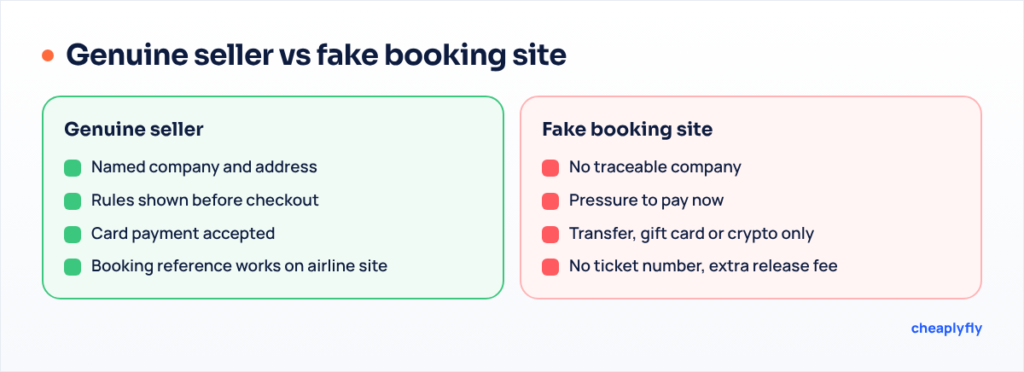
- The price is far below what the airline’s own site and other sellers show for the same flight.
- You are pushed to pay now: countdown timers, “last seat” warnings or a call from an agent who insists on speed.
- The only payment options are bank transfer, gift cards, payment apps or cryptocurrency, or card payment “fails” and you are steered to one of these.
- The web address is slightly off: an extra word, a swapped letter or an unusual ending.
- There is no company name, registered address or terms and conditions, or they are copied from another site.
- Contact is only by chat app or a mobile number, with no traceable business details.
- The confirmation has no airline booking reference or ticket number, or asks for an extra fee to “release” the ticket.
- Someone contacted you first, by text, social media or phone, about a booking you did not ask about.
Very cheap fares do exist. Mistake fares and short sales are real, and our guide to error fares and flash sales explains how to spot genuine ones. The difference is that a genuine deal appears on the airline’s own site or through known sellers, and you pay with ordinary methods.
Myth: A padlock in the address bar means the site is safe.
Fact: The padlock means the connection is encrypted. As the FTC points out, a scammer’s site can be encrypted too; it only means nobody else can read the data on its way to the scammer.
Myth: The top search result is the official site.
Fact: The top results are often paid ads. Scroll past them, or type the company’s address yourself.
Myth: Good reviews mean a site is genuine.
Fact: Reviews can be faked. Search the company name with words like “scam” or “complaint” and look for independent reports.
Verify before you pay: a five-minute routine
Run through these steps whenever you book with a seller you have not used before. They take a few minutes and catch most fake travel booking sites.
-
Check the same flight on the airline’s own site
Note the flight number, date and times, then look them up on the airline’s official website. If the flight does not exist, or the price gap is huge, walk away.
-
Identify the company behind the site
Look for the legal company name, registered address and terms of sale. Search the name with “scam”, “review” and “complaint”, as the FTC recommends. A business that hides who it is should not get your money.
-
Check the web address character by character
Type the address yourself rather than clicking a link or an ad. Look closely at spelling and the domain ending.
-
Read the rules before paying
Real sellers show baggage, change and refund rules before checkout. Get the cancellation and refund policy in writing.
-
Pay with a protected method
Use a credit card where possible; card payments come with dispute rights in many countries. Never pay by wire transfer, gift card or crypto for a flight. Our guide to paying for flights, currencies and cards compares payment options in more detail.
-
Confirm the ticket with the airline
Within a day of booking, enter the airline booking reference on the airline’s “manage booking” page. If it is not found, or the airline has no ticket number for you, contact your card issuer at once.
Cheaplyfly is a search and comparison site. You compare fares here, then book and pay on the airline’s or travel agency’s own website, and that company issues your ticket. We never ask for payment by phone, chat or bank transfer. See how it works.
Staying safe while you travel
Scams do not stop once the trip is booked. Fake “flight change” texts and impostor support accounts target travelers who are already on the move and more likely to act quickly.
- Use the airline’s app or website to check any change, never a link in a message.
- At the airport, speak to staff at the desk or gate rather than calling a number you found online.
- Avoid entering card details on unfamiliar networks; our guide to staying connected abroad covers mobile data and safer ways to get online.
- Never share your password, a one-time code or a full card number with someone who contacted you first.
What to do if you were scammed
If you paid one of these fake travel booking sites, speed matters. The sooner you act, the better the chance of stopping or reversing a payment. Work through this timeline.
- Immediately
Call your card issuer or bank using the number on your card. Ask them to block the card and stop or dispute the payment. Change any password you entered on the fake site.
- Within a few days
Send a written dispute to your card issuer. In the US, the Consumer Financial Protection Bureau explains that billing error disputes must reach the issuer within 60 days of the first statement showing the charge. Other countries have similar card dispute processes; ask your bank about the deadline.
- Same week
Report the scam to the right authority (see below) and to the real airline or company the scammer impersonated. Keep screenshots, the website address, emails and payment records.
- Before your travel date
If you still need to travel, book again through a verified seller. Do not pay anyone who offers to “recover” your money for a fee; that is often a second scam.
Where to report, by region
| Region | Where to report |
|---|---|
| Any country, cross-border scams | econsumer.gov, supported by consumer protection agencies in many countries |
| United States | ReportFraud.ftc.gov (FTC) |
| United Kingdom | Report Fraud, the national service that replaced Action Fraud in Dec 2025 |
| Canada | Canadian Anti-Fraud reporting (CAFC), plus your local police if you lost money |
| Australia | Scamwatch, plus a police report for cybercrime losses |
| European Union | Your national police, and the European Consumer Center network (ECC-Net) for cross-border disputes with a trader |
Reporting rarely brings money back on its own, but it helps authorities connect cases and warn other travelers. Your bank or card issuer is the main route to recovering funds.
Frequently asked questions
How can I tell if a flight booking is real?
Take the airline booking reference from your confirmation and enter it, with your surname, on the airline’s own “manage booking” page. A real booking shows your flights and, once issued, a ticket number.
Is a very cheap fare always a scam?
No. Sales and mistake fares happen. Check that the same price appears on the airline’s site or a known seller, and pay by card, never by transfer or gift card.
What should I do if I gave my card details to a fake site?
Call your card issuer straight away to block the card and dispute any charges, then watch your statements. Change any passwords you used on the site.
Can I get my money back from a bank transfer?
It is harder than with a card, but contact your bank immediately. Some banks can try to recall a payment or may refund scam victims under local rules, so ask what applies.
Does the airline help if I booked through a fake site?
If no real ticket was issued, the airline has no booking for you. Report the impersonation to the airline anyway, so it can warn other customers.
Can Cheaplyfly cancel or refund a booking?
No. Cheaplyfly helps you compare flights; the airline or travel agency you paid issues the ticket and handles changes and refunds.
Sources
- FTC Consumer Advice: Avoid Scams When You Travel
- FTC Consumer Advice: How to avoid a travel scam this summer (Jun 2026)
- FTC Consumer Advice: Scammers impersonate airline customer service representatives
- FTC Consumer Advice: Are Public Wi-Fi Networks Safe?
- Consumer Financial Protection Bureau: How do I dispute a charge on my credit card bill?
- econsumer.gov: Report international scams
- Scamwatch: Report a scam