One-Way, Round-Trip or Multi-City: Which Ticket Type Saves More?
One-way, round-trip or multi-city? See how each ticket shape is priced, when it wins, and how an open jaw can save a travel day.

One way vs round trip is one of the first choices on any flight search, and multi-city adds a third option that many travelers skip. The cheapest ticket type depends on the airline, the route and how sure you are of your return date. This guide draws each itinerary shape in words, shows when each one wins, and explains the open-jaw trick that sits between them.
Key takeaways
- Many low-cost airlines price each direction separately, so two one-way tickets often cost the same as a return.
- Some full-service airlines still price return trips below two one-ways, especially on long-haul routes. Always compare both.
- Multi-city and open-jaw tickets let you fly into one city and home from another, often for close to a simple return fare.
- Coupons on one ticket must normally be flown in order. Missing a leg can cancel the rest of the booking.
- Two separate one-ways give flexibility, but each ticket stands alone if something goes wrong.
Three itinerary shapes, drawn in words
Before comparing prices, picture what each ticket type looks like on a map. The shape tells you what the airline is selling and what happens if plans change.
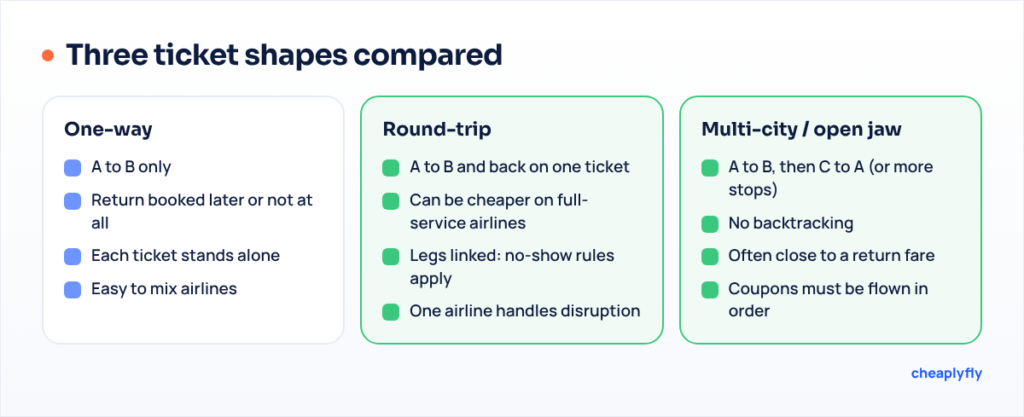
Shape 1: the one-way line
A single arrow from A to B. Nothing ties you to a return. If you buy a second one-way back, that is a new arrow on a new ticket, possibly with a different airline and on a date you choose later. Each line is a separate contract with its own rules and its own protection.
Shape 2: the round-trip loop
An arrow from A to B and another from B back to A, on one ticket. The airline prices the loop as a whole, so the return can be cheaper than it looks on its own. The two halves are linked: changes, refunds and no-show rules apply to the whole booking.
Shape 3: the multi-city chain
A series of arrows such as A to B, B to C, then C to A, all on one ticket. The chain can cover several countries, with stays of days or weeks between flights. An open jaw is a special chain with a gap: A to B, then C back to A, and you cover the ground between B and C by train, bus or car.
One way vs round trip: how airlines actually price them
There is no single global rule. Pricing depends on each airline’s fare structure, which is why comparing both options on every search pays off.
Airlines that price each direction separately
Most low-cost carriers sell every flight as its own fare. A return ticket on these airlines is effectively two one-ways in one basket, and the total is the same either way. That makes it easy to mix airlines: out on one carrier, home on another, each on the cheapest day.
Airlines that reward the return
Many full-service airlines file fares that only work as part of a return trip, sometimes with minimum-stay or advance-purchase conditions. On these routes, a one-way can cost close to or even more than a full return. The pattern is most common on long-haul and international routes, though it varies widely.
Run the same dates three ways: as a return, as two one-ways, and as two one-ways on different airlines. It takes a few minutes and shows which pricing model the route follows. Our step-by-step guide on how to find cheap flights builds this comparison into a repeatable routine.
Flexible dates change the answer
One-ways shine when your dates are uncertain or when the cheapest outbound and return days fall on different weeks. A price calendar makes this visible. Our guide to reading a flight price calendar shows how to spot the cheapest day in each direction separately, which is exactly what two one-ways let you book.
The “when each wins” matrix
Use this matrix as a starting point. The right column shows the ticket type that usually wins for each situation, but a quick search should confirm it every time.
| Situation | One-way | Round-trip | Multi-city / open jaw |
|---|---|---|---|
| Return date not yet known | Wins: book the return later | Risky unless changes are cheap | Not suitable |
| Low-cost airline both ways | Same price, more freedom | Same price, one booking | Rarely offered |
| Long-haul on a full-service airline | Often expensive | Often wins | Competitive if cities differ |
| Fly into one city, home from another | Works, two contracts | Forces backtracking | Wins: one ticket, no backtrack |
| Several stops over a few weeks | Flexible but many tickets | Not suitable | Wins on simplicity and protection |
| Using points for one direction | Wins if the program prices one-way awards | Depends on the program | Depends on the program |
The last row matters for anyone with a loyalty balance. Many programs price awards per direction, which makes it easy to pay cash one way and use points the other. The points and miles basics guide explains how to judge whether points or cash is the better deal for each leg.
Open jaw explained
An open jaw is a trip where the return does not start where the outbound ended, or does not end where the outbound began. The fare industry treats it as a permitted way of combining fares: ATPCO, which distributes airline fare data, describes open jaws in its overview of fare rule categories as flying into one city and returning from another, governed by each fare’s combination rules.
The two common forms
- Destination open jaw: fly from home into city B, travel overland, then fly home from city C. Ideal for a rail trip or road trip across a region.
- Origin open jaw: fly out from airport A and return to a different airport A2 near home. Handy when two airports serve the same area and one has the better return flight.
On a full-service airline, an open jaw is often priced as two halves of a return, so it can cost about the same as a simple round trip. On low-cost airlines, you simply book two one-ways. Either way, the open jaw removes the cost and time of traveling back to your arrival city just to fly home.
Worked example (illustrative)
A traveler plans two weeks touring a region by train. Option one is a return to the first city, plus a long train ride back at the end. Option two is a multi-city ticket into the first city and home from the last. If the multi-city fare is close to the return fare, option two saves a full travel day and the backtracking train ticket. The specifics vary by route; the point is to price both before deciding.
The rules that link legs on one ticket
A round-trip or multi-city ticket is one contract. That brings protection, but it also brings rules about how the legs are used.
Coupons must be used in order
Airline conditions of carriage commonly say a ticket is valid only for the sequence of flights shown on it. Austrian Airlines’ general conditions of carriage, for example, state that the ticket is only valid for the sequence of carriage shown, and that if legs are skipped or used out of order, the airline may recalculate the fare for the route actually flown.
A no-show can cancel the rest
If you miss a flight without telling the airline, many carriers cancel the remaining flights on that ticket, including your return. Delta’s no-show policy (updated 18 Dec 2025) says a passenger who no-shows without notifying the airline forfeits the value of the ticket. European consumer group BEUC’s questions and answers on no-show clauses explain how these terms work in practice.
If you will miss the outbound of a round trip, contact the airline before departure and ask to keep the return. Doing nothing usually means losing it.
Separate one-ways stand alone
Two one-way tickets avoid the no-show chain: missing the first does not touch the second. The trade-off is that a delay on one ticket is not the other airline’s problem. When separate tickets connect on the same day, you are in self-transfer territory, and our guide to self-transfer risks explains the buffers to plan.
A quick way to decide
-
Fix the shape of the trip
Are you returning to the same city, flying home from somewhere else, or making several stops? That narrows the choice to one or two ticket types.
-
Check how sure your dates are
Fixed dates favor a round trip or multi-city. Uncertain return dates favor a one-way now and a second one-way later.
-
Price every valid option
Search the same dates as a return, as two one-ways and, where it fits, as a multi-city. Compare the totals including bags.
-
Weigh the protection
If the gap in price is small, the single ticket usually wins because one airline is responsible for the whole trip.
Frequently asked questions
Is one way vs round trip cheaper on low-cost airlines?
Usually neither. Most low-cost airlines price each flight separately, so a return costs the sum of two one-ways. Compare anyway, because different days or airlines in each direction can lower the total.
Why is a one-way sometimes more expensive than a return?
Some full-service airlines file their cheapest fares only as part of a return trip. On those routes, the one-way fare may be a higher, more flexible fare type.
Can I skip the return flight on a round-trip ticket?
Not using the last flight does not usually cancel earlier legs, but airline conditions vary and some allow the fare to be recalculated if a ticket is not flown as booked. Check the conditions of carriage before relying on it.
What is the difference between multi-city and open jaw?
Multi-city is any one ticket with several flights between different cities. An open jaw is a specific multi-city shape where you fly into one city and home from another, covering the gap on the ground.
Do multi-city tickets protect my connections?
Flights on one ticket are one contract, so the airline is responsible for getting you through the booked itinerary. Stopovers of days or weeks are planned stays, not connections, so check the rules for each leg.
Can I book a multi-city trip on Cheaplyfly?
You can search and compare itineraries on Cheaplyfly. Booking and payment happen with the airline or travel agency you choose, and their terms apply.