Flexible Dates: How to Read a Flight Price Calendar and Save
How to read a flight price calendar, what each pattern means, and a worked example comparing three date pairs.

Searching flexible dates flights instead of fixed days is one of the simplest ways to pay less for the same trip. A price calendar lays out fares across days or weeks so you can see the cheaper pairs at a glance. This guide shows you how to read one properly, what each pattern means, and how to compare date pairs on total cost rather than headline price.
Key takeaways
- A price calendar shows the lowest fare found for each date or date pair, usually from recent searches. Always confirm the live price before booking.
- Patterns tell a story: weekend peaks, midweek dips, holiday blocks and a steady rise near departure each have a cause.
- Compare date pairs on the whole trip cost, including extra hotel nights, bags and transfers.
- Shifting by one or two days is often enough. You rarely need to move a trip by weeks.
What a flight price calendar actually shows
A price calendar is a grid of dates with a fare on each one. In a one-way view, each day shows the lowest price found for departing that day. In a round-trip view, you either pick a departure and see return prices, or you see a two-way grid where rows are departure dates and columns are return dates.
Most calendars shade cells by price, so cheaper days stand out. That shading is relative to the other prices on the screen, not to some absolute standard. A “green” day on an expensive route can still cost more than a “red” day on a cheap one.
Calendar prices are usually indicative. They come from recent searches and can be a few hours or days old, so a fare may have changed by the time you click. Treat the calendar as a map and the live result as the final answer.
In several regions, rules require the displayed fare to include unavoidable taxes and fees. In the European Union, for example, Regulation (EC) No 1008/2008 requires the final price to be shown at all times. Even so, optional extras such as bags and seats are not in the calendar figure, so the cheapest cell is not always the cheapest trip.
Reading the patterns: an annotated walkthrough
Once you know what to look for, most calendars fall into a handful of recognizable shapes. Here is what each one usually means and how to respond.
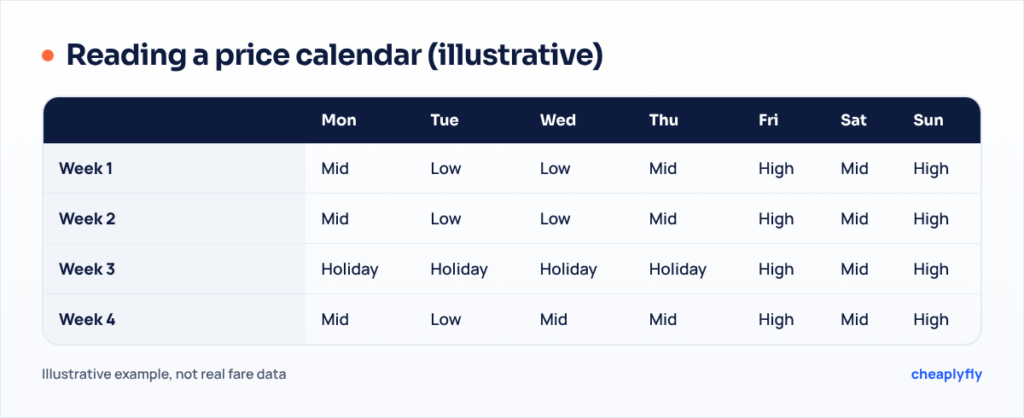
- Pattern 1: A cheaper column in the middle of the week
- Many routes see lower demand on certain weekdays, so those columns shade cheaper. The US Department of Transportation notes that the best deals may be limited to certain days of the week or times of day. Response: test leaving or returning on those days first.
- Pattern 2: Weekend spikes
- Fridays and Sundays are popular on routes with lots of short leisure or commuter trips. If the price jumps on the same weekdays every week, that is demand, not chance. Response: try a Thursday departure or Monday return.
- Pattern 3: A solid expensive block
- Several days in a row priced well above their neighbors usually mark a holiday, festival or large event at one end of the route. Response: move outside the block if you can, or book early if you cannot.
- Pattern 4: A steady climb toward the near dates
- Prices rising day by day as you move toward today usually mean the lower fare levels are closing on the nearest flights. Response: if your trip is soon, decide quickly. Our guide on the best time to book flights explains why.
- Pattern 5: One isolated cheap cell
- A single low price among higher ones may be a last cheap seat, an odd connection, or a stale price. Response: click it and check the live fare, the flight times and the number of stops before getting excited.
- Pattern 6: Blank cells or no price
- Blanks can mean no flights that day, no recent search, or dates beyond the airline’s schedule. Many airlines only sell about a year ahead; British Airways, for example, sells up to 355 days ahead. Response: run a direct search for that date.
- Pattern 7: A cheaper diagonal in a two-way grid
- When one trip length is consistently cheaper, you will see a diagonal band of lighter cells. Some discounted fares have conditions such as a minimum stay. Response: check whether lengthening or shortening the trip by a night falls on that band.
Worked example: comparing three flexible dates flights options
A calendar shows you cheap cells. The real decision is which date pair gives the best trip for the money. This example uses illustrative numbers in USD to show the method.
Worked example
A traveler wants a seven-night city break and can leave any day within one week. The calendar suggests three date pairs. Each fare is a round-trip price for one person and is illustrative only.
Pair A leaves on a Friday and returns the next Friday. The fare is the highest of the three, but the flight times are convenient and no extra leave from work is needed.
Pair B leaves on a Tuesday and returns the next Tuesday. The fare is the lowest, but the return lands late at night, so the traveler would need a taxi rather than public transport.
Pair C leaves on a Wednesday and returns the following Thursday. The fare sits in the middle, but the trip is eight nights, which adds a night of accommodation.
| Item (illustrative, USD) | Pair A: Fri to Fri | Pair B: Tue to Tue | Pair C: Wed to Thu |
|---|---|---|---|
| Round-trip fare | 420 | 310 | 340 |
| Checked bag, both ways | Included | 60 | Included |
| Extra accommodation | 0 | 0 | 110 |
| Late-night transfer | 0 | 45 | 0 |
| Total trip cost | 420 | 415 | 450 |
The cheapest cell on the calendar, Pair B, ends up only slightly cheaper than Pair A once the bag and the taxi are added. Pair C, which looked like a solid middle option, is the most expensive trip. The lesson is not that one pair always wins. It is that the calendar finds candidates, and a quick total-cost check picks the winner.
Round trip, one-way and open-jaw views
Calendars behave differently depending on the trip type. A round-trip calendar prices the two directions together, which may be cheaper or more expensive than two one-way tickets. On routes with several airlines, run a one-way calendar for each direction as well and compare.
If you want to fly into one city and home from another, a multi-city search is the right tool, though it may not offer a full calendar view. Our guide to one-way, round-trip and multi-city tickets explains when each is worth testing. The DOT also lists conditions such as round-trip purchase and minimum stays as common restrictions on discounted fares, so read the rules of the fare you pick in its Buying a Ticket guidance.
Common traps when reading a calendar
Before you choose your dates, check that
- The price shown is per traveler or for the whole group, and you have multiplied correctly.
- The live fare matches the calendar, or is close enough to still be worth it.
- The arrival time works for you, including late-night or overnight arrivals across time zones.
- The cheaper fare includes the bags you need, or you have added the bag cost.
- Any extra night of accommodation or extra day off work is part of your comparison.
- The price is in the currency your card will charge, or you have allowed for conversion.
A common mistake is treating the calendar as live inventory. Another is comparing a one-way calendar price with a round-trip calendar price, which are different products. Keep each comparison like for like.
Using seasons and timing with flexible dates flights
Date flexibility works best when you combine it with the bigger picture. Moving a trip by a day saves money within a week, but moving it from a peak month to a shoulder month can change the whole price level. Our guide to peak, shoulder and off-season travel covers that wider view.
Timing matters too. A calendar viewed three months ahead will look different from the same calendar viewed three weeks ahead, because cheaper fare levels close as departure gets nearer. When you find a date pair and total cost you are happy with, book it or set an alert, rather than waiting for the calendar to turn greener.
For the full search routine around this step, including airports, connections and alerts, see how to find cheap flights step by step. When you are ready, open the flight search, choose flexible dates, and work through the patterns above.
Frequently asked questions
Why is the price different when I click a date on the calendar?
Calendar prices usually come from recent searches and can be out of date. When you click, a live search runs and returns the current fare, which may be higher or lower.
How many days of flexibility do I need to save money?
Often just one or two days either side of your preferred dates is enough to reveal cheaper pairs. Wider flexibility helps most around holidays and busy events.
Is the cheapest date on the calendar always the best choice?
No. Add bags, transfers, extra accommodation and time off work. A slightly higher fare with better times or included bags can be the cheaper trip overall.
Why are some dates blank on the calendar?
There may be no flights that day, no recent price, or the date may be beyond the airline’s booking window. Run a direct search for that date to check.
Do calendar prices include taxes?
In many regions, displayed fares must include unavoidable taxes and fees, but optional extras like bags and seats are not included. Always check the final price on the booking site.
Should I use a one-way or round-trip calendar?
Try both. A round-trip calendar is convenient, but two one-way tickets can sometimes be cheaper, especially on routes with several airlines.