How Flight Search Engines Work (and How to Use Them Well)
Search engines compare fares and send you to the seller to book. Here is how results are built, why prices move, and who helps you after booking.
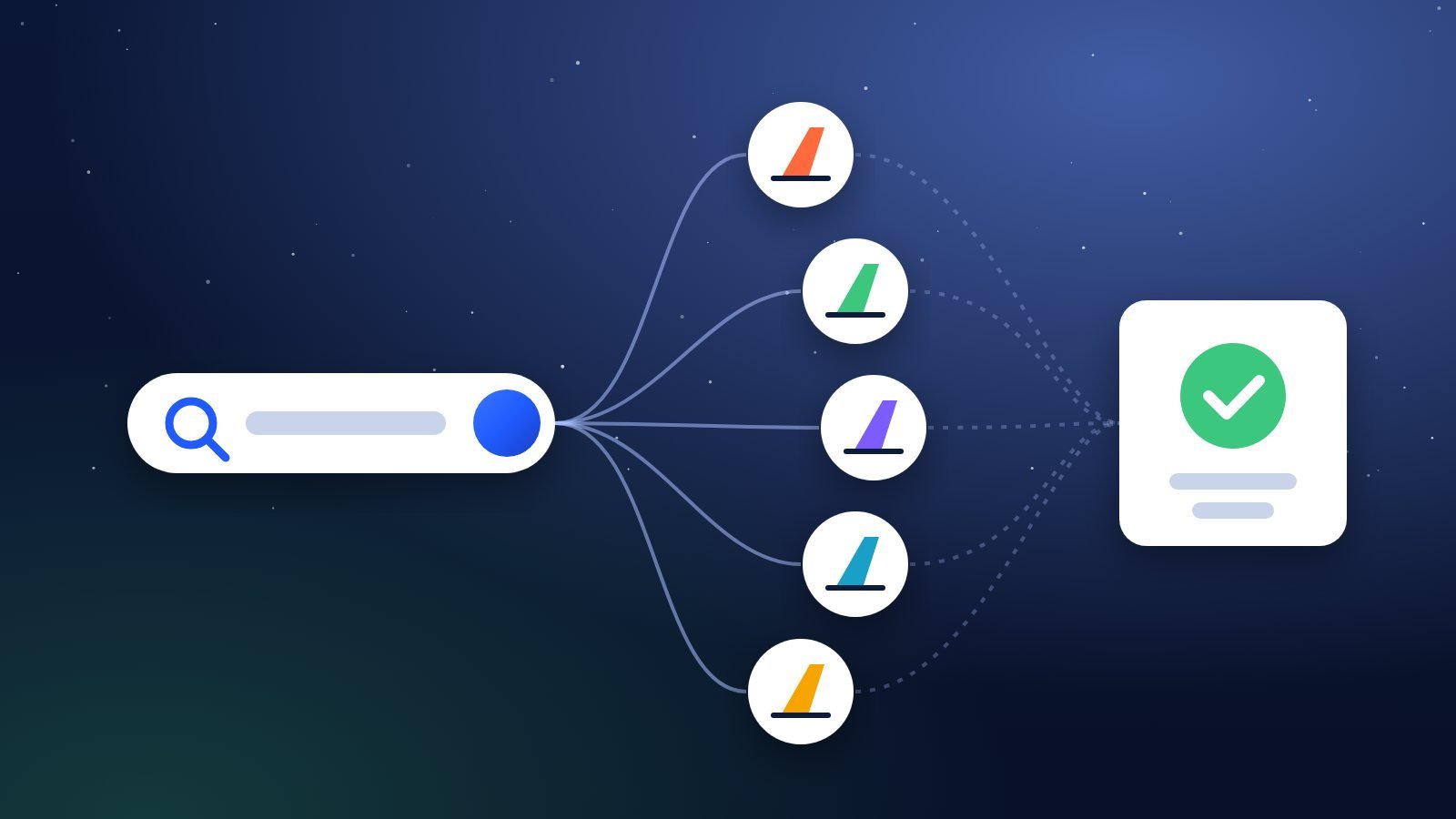
Knowing how flight search engines work helps you read results with confidence: why prices shift when you click, why the same flight appears from several sellers, and who to call when plans change. In short, a search engine collects fares from airlines and travel agencies, shows them side by side, and sends you to the seller to book. This guide explains each step and how to use it to your advantage.
Key takeaways
- A metasearch site such as Cheaplyfly compares prices and sends you to an airline or agency to book; it does not sell the ticket.
- The company you pay is the one that handles changes, refunds and most after-booking questions.
- Prices can change between the results page and checkout because fares and seat availability move constantly.
- Comparing sellers is about more than price: check the fare rules, bags and the seller’s support options.
- Filters, flexible dates and price alerts turn a single search into a strategy.
How flight search engines work, step by step
When you enter a route and dates, the search engine sends that request to many data sources at once, gathers the answers, and ranks them for you. Behind that simple box there are three kinds of business that often get confused.
- Metasearch engine
- A comparison site that queries airlines and travel agencies, shows their prices together and sends you to the seller you choose. It does not take your payment or issue a ticket. Cheaplyfly works this way.
- Online travel agency (OTA)
- A company that sells tickets on behalf of airlines. You pay the agency, it issues or arranges the ticket, and it is usually your first contact for changes to the booking.
- Airline direct
- Booking on the airline’s own website or app. You pay the airline and deal with it for everything.
- Global distribution system (GDS)
- Industry systems that many agencies use to see airline schedules, fares and availability.
- NDC
- New Distribution Capability, an industry data standard from IATA that lets airlines send richer offers, such as bundles and extras, to sellers through modern connections.
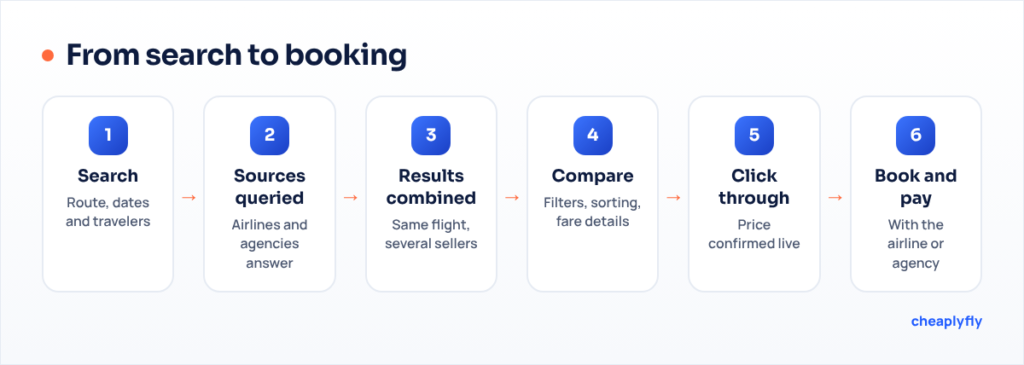
The journey of one search
- You search. Route, dates, travelers and cabin go to the engine.
- The engine asks its sources. Airlines and agencies return available flights and prices, through direct connections or industry systems.
- Results are combined. Duplicate flights from different sellers are grouped, so you may see one itinerary with several prices.
- You compare and choose. Filters and sorting help you narrow down by price, duration, stops and times.
- You click through. The engine sends you to the seller’s site, where the price is confirmed live.
- You book and pay the seller. From here, your contract is with the airline or agency you paid.
Where the prices come from
Airlines file fares and decide how many seats to sell at each price level. Those price levels are called fare classes, and as cheaper ones sell out, the lowest available price rises. Our guide to fare classes and fare families explains why the same seat can carry very different rules.
Sellers then reach that content in different ways. Many agencies use global distribution systems, while airlines increasingly offer content through modern interfaces built on IATA’s standard. IATA describes NDC as an XML-based standard that lets airlines create and distribute offers across sales channels, and its NDC fact sheet notes that each airline decides whether and how fast to adopt it. That is one reason a given extra, such as a bundle with a bag, may be visible with one seller and not another.
Why the price can change when you click
Checking every airline and agency live for every search would be slow, so search engines often combine live answers with recently stored ones. Meanwhile, seats keep selling. If the cheapest fare class sells out between your search and your click, the seller will show the next price up. This is normal, not a trick, and it is why the price on the seller’s page is the one that counts.
If a price jumps at click-through, go back and check another seller for the same flight, or try nearby dates. A small change in departure day can land on a different fare class.
Metasearch vs travel agency vs airline: who supports you after booking
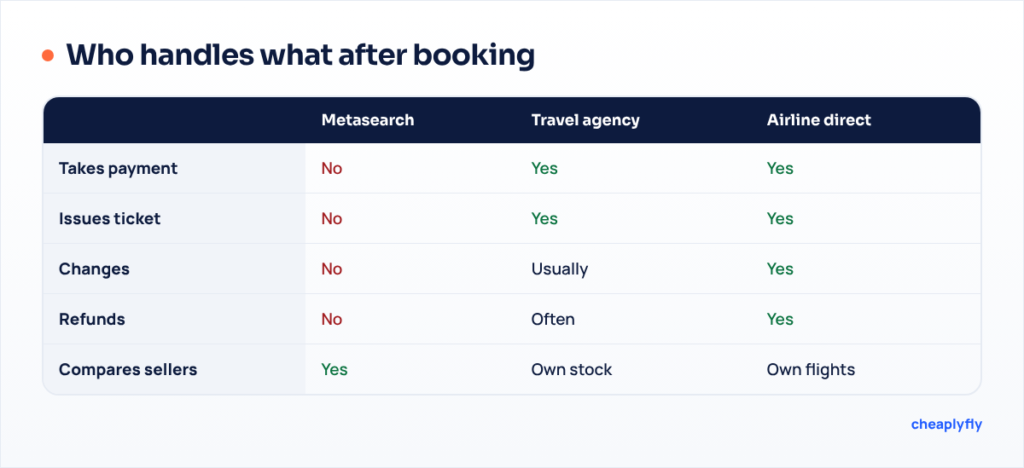
The single most useful fact about flight search is this: the company you pay is the one responsible for your booking. A metasearch engine helps you find and compare; it hands you over before payment. The airline still operates the flight, so some matters, like check-in and what happens at the airport, are always with the airline.
| After-booking task | Metasearch site | Online travel agency | Airline direct |
|---|---|---|---|
| Takes your payment | No | Yes | Yes |
| Issues your ticket and confirmation | No | Yes, or arranges it with the airline | Yes |
| Voluntary changes and cancellations | No, contact the seller | Usually first contact; airline rules apply | Yes |
| Refunds when owed | No | Often, especially when it took the payment | Yes |
| Schedule changes and disruption | No | Passes on airline changes; may rebook | Yes, directly |
| Check-in, seats, bags at the airport | No | Airline handles at the airport | Yes |
| Price comparison across sellers | Yes, its main job | Within its own inventory | Own flights only |
As a regional example, US rules make this explicit for refunds. Under the Department of Transportation’s refund rules, a ticket agent that is the merchant of record, meaning the company named on your card statement, is responsible for issuing a refund when one is due; see 14 CFR 399.80. Rules differ elsewhere, so check who you are paying before you pay.
How results are ranked and what “best” means
Most engines let you sort by cheapest, fastest or a blended “best” score that balances price, duration and stops. A blended score is a starting point, not a verdict. Two flights can rank close together while one lands at midnight and the other mid-afternoon.
Metasearch sites are usually paid by their partners, for example a commission when a traveler books after clicking through. That is how comparison stays free for travelers. A good engine still shows you the price and the seller clearly, so you can choose on your own terms.
Hidden differences between identical flights
The same flight number from two sellers is not always the same product. Check these before choosing the cheapest seller:
- Fare rules: one offer may be a basic fare without a checked bag or changes.
- Connections: some offers combine separate tickets. Read our guide to self-transfer flights and their risks before booking one.
- Payment and currency: sellers may price in different currencies or add card charges where allowed. Our guide to paying for flights explains what to watch.
- Support: how easy is it to reach the seller if something changes?
Using flight search engines well
Once you understand how flight search engines work, you can use them more deliberately. A single search is a snapshot. A few habits turn it into a method that reliably finds better fares and fewer surprises.
A smart search routine
- Search with flexible dates or a price calendar before fixing your days.
- Include nearby airports in your search where it makes sense.
- Filter by stops and times you can actually live with, then sort by price.
- Open the fare details and check bags, changes and refunds.
- Compare at least two sellers for the same flight.
- Set a price alert if you are not ready to book today.
Price alerts are especially useful because fares move often. Our guide to flight price alerts covers how to set them without drowning in notifications, and the broader playbook on how to find cheap flights brings all the tactics together. On Cheaplyfly, you can read how our search works or go straight to a flight search.
Your rights right after booking
Some protections apply in the hours after you book, but they depend on region and seller. As a US example, airlines covered by 14 CFR 259.5 must let customers either hold a reservation at the quoted fare for 24 hours without payment or cancel within 24 hours without penalty, when the booking is made at least one week before departure. The airline chooses which option it offers.
That rule is about airlines; agencies may have their own policies. Other regions have no equivalent, so never assume a free cancellation window exists. Our guide to refunds and the 24-hour cancellation rule explains when you can get your money back and from whom.
A metasearch site cannot cancel, change or refund your booking, because it never held it. Contact the airline or agency named on your confirmation email.
Frequently asked questions
Does Cheaplyfly sell flight tickets?
No. Cheaplyfly is a metasearch site: it compares prices from airlines and travel agencies and sends you to the seller you choose. You book and pay on that seller’s site, and the seller handles your booking.
Why is the price different on the airline or agency site?
Fares and seat availability change constantly, and some results are based on recently stored prices. The price confirmed on the seller’s page is the one you pay.
Who do I contact to change or cancel a booking?
The company you paid. That is usually the airline if you booked direct, or the travel agency if you booked through one. Check your confirmation email for the seller’s name.
Is it safe to book with a travel agency instead of the airline?
Many agencies are reliable, and they can offer good prices. Check the fare rules, the payment details and how to reach their support before you pay.
Is it cheaper to book direct with the airline?
Sometimes, sometimes not. Agencies and airlines can price the same flight differently. Comparing both is the point of a search engine.
Do I need to understand how flight search engines work to find a good fare?
Not in depth, but knowing that prices move and that the seller handles your booking helps you avoid most surprises.
How do flight search engines make money?
Usually through payments from partners, such as a commission when a traveler books after clicking through, or through advertising. Searching stays free for the traveler.