How to Find Cheap Flights: A Step-by-Step System That Works Anywhere
A repeatable nine-step search system for any trip, and a clear look at where each saving comes from.

Learning how to find cheap flights is less about secret tricks and more about running the same careful search every time. This guide gives you a nine-step system that works for any route, any currency and any season, and shows you exactly where the savings in each step come from.
Key takeaways
- Most savings come from flexibility: dates, airports, routing and timing matter far more than any one trick.
- Compare the total trip cost, not the headline fare. Bags, seats and payment charges can reverse a “cheap” result.
- Search wide first, then narrow down. Lock in the trip shape before you fine-tune the details.
- Use price alerts and the 24-hour window where it applies, so you are not forced to decide in a hurry.
- Book with the company whose rules you understand, because that company handles changes and refunds.
Why a system beats hunting for tricks
Airfares move constantly. Airlines release seats in price tiers, and when the cheapest tier on a flight sells out, the next search shows a higher number. That is why two people searching the same route a day apart can see different prices, and why one-off hacks rarely work twice.
A repeatable process protects you from that noise, and it is the most reliable answer to how to find cheap flights on any route. You decide what actually matters for the trip, explore the options in a fixed order, and only commit when the total price and the rules both make sense. If you want to understand what happens behind the results page, read our explainer on how flight search engines find and rank fares.
Cheaplyfly is a search and comparison site. You compare flights here, then book and pay on the airline’s or travel agency’s own site. That company issues the ticket and handles any changes or refunds.
The 9-step system for how to find cheap flights
Work through these steps in order. Steps 1 to 4 shape the trip, steps 5 to 7 test the price, and steps 8 and 9 make sure the deal is real before you pay.
-
Write down your fixed points
Before searching, note what cannot move: a wedding date, a start date at work, the number of nights you need. Everything else is a variable you can test. Travelers who skip this step often anchor on the first dates they typed and never check the cheaper ones beside them.
-
Search with flexible dates first
Start with a month view or a date range rather than exact days. A price calendar shows at a glance which departure and return pairs are cheaper. Our guide to reading a flight price calendar explains the patterns to look for. The US Department of Transportation also notes that the best deals may be limited to certain days of the week or times of day.
-
Widen the airport net
Large cities often have more than one airport, and a smaller airport within reasonable distance may be served by different airlines. Add those airports to your search on both ends of the trip. We cover the trade-offs in detail in nearby airports and alternative routes.
-
Compare nonstop with one-stop options
A connection is sometimes cheaper than a nonstop, especially on long-haul routes. Weigh the saving against the extra travel time and the connection length. A very short layover is a real risk, so check the minimum time before you choose it.
-
Check the timing of your booking
There is no magic day of the week to buy, but there is a sensible window for most trips. Booking very late usually costs more because the cheapest seats are gone, and booking at the very edge of the schedule can mean fewer fare options. See the best time to book flights for a full timeline.
-
Test one-way and round-trip pricing
On some routes, two one-way tickets on different airlines cost less than a round trip. On others, the round trip is clearly cheaper. Run both searches. If you combine separate tickets, remember that each ticket is its own contract, so a delay on one may not be covered by the other.
-
Set a price alert instead of refreshing
If the trip is weeks or months away and the price looks high, set an alert and let the fare come to you. Read how flight price alerts work to know what to do when one fires. You can create one from the price alerts page.
-
Price the whole trip, not the fare
Add the bags you need, any seat you must choose, and any payment charge. A basic fare with one checked bag can end up costing more than a standard fare that already includes it. Our guide to the true cost of a cheap fare walks through every add-on.
-
Read the rules, then book
Before paying, read the fare conditions on the booking site: change fees, refund rules, baggage allowance and name-change policy. Check who operates each flight, since a code-share flight may be sold by one airline and flown by another. Then book on the partner’s site and save the confirmation.
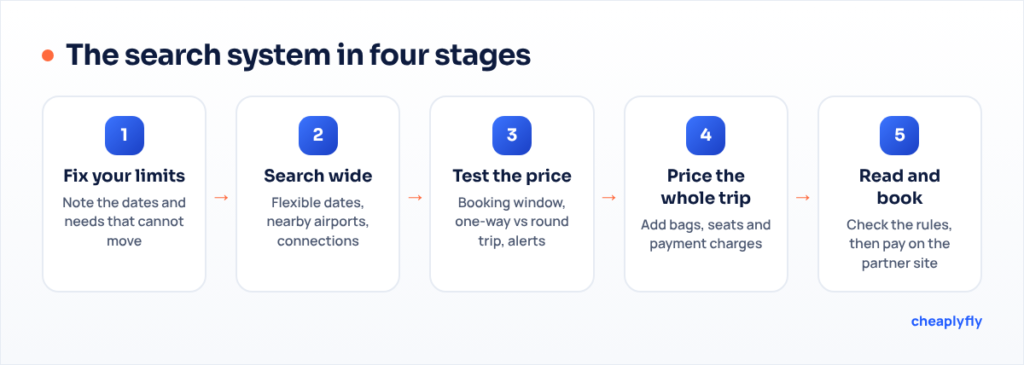
Where the savings come from
Each step saves money for a different reason. Knowing the reason helps you decide which steps deserve more time on a given trip. The table below describes the mechanism, not a guaranteed amount, because savings vary by route and season.
| Step | Why it can lower the price | When it helps most |
|---|---|---|
| Flexible dates | Demand is uneven across the week and the season, so some days have cheaper seats still available. | Leisure trips with a few days of slack |
| Nearby airports | Different airports attract different airlines, and competition tends to push fares down. | Large metro areas and regions with several airports |
| Connections | Connecting itineraries are sometimes priced lower than nonstops on the same route, as airlines compete for traffic through their hubs. | Long-haul trips where time is less critical |
| Booking window | The cheapest fare tiers on a flight tend to sell first, so waiting too long removes them. | Peak dates and popular routes |
| One-way combinations | Mixing airlines can pair the cheapest outbound with the cheapest return. | Routes served by several carriers |
| Price alerts | You catch short-lived drops without checking every day. | Trips that are more than a few weeks away |
| Total-cost check | You avoid add-ons that turn a low fare into an expensive trip. | Any trip with checked bags or seat needs |
Notice that the biggest levers are about the trip itself, not the moment you click “search”. Dates, airports and routing usually move the price far more than browser settings or the day of the week you happen to be shopping.
Comparing prices fairly across sites and currencies
A fair comparison means comparing like with like. Check that both prices include the same bags, the same fare type and the same number of travelers. In several regions, the law requires the advertised fare to include unavoidable taxes and fees, which makes comparison easier.
Regional examples of price display rules
In the European Union, Regulation (EC) No 1008/2008 requires the final price, including unavoidable taxes, charges and fees, to be shown at all times, and optional extras to be offered on an opt-in basis. In the United States, the Department of Transportation requires advertised fares to include government taxes and mandatory carrier charges. Rules differ elsewhere, so check the total on the final booking page wherever you are.
Currency and card charges
The same fare can be shown in two currencies, and the cheaper-looking one is not always cheaper once your card provider converts it. Check whether your card charges a foreign transaction fee, and compare the final amount in the currency your bank will actually bill. When a booking site offers to charge you in your home currency, compare that rate with your card’s own rate before accepting.
Keep a short note of each candidate: total price, bags included, change rules and who you would book with. Five lines of notes make the final decision easy and stop you from chasing a price you have already beaten.
Common mistakes that cost travelers money
- Searching exact dates only. Moving a trip by a day or two is often the single easiest saving.
- Ignoring the baggage line. A low fare without a bag can overtake a higher fare that includes one.
- Booking a tight self-made connection. Separate tickets do not usually protect you if the first flight runs late.
- Waiting for a perfect price. Fares can rise as well as fall. Decide on a price you are happy with and book when you see it.
- Not reading who handles changes. The airline or travel agency you book with sets the rules for refunds and changes, so read them before you pay.
Protecting your booking after you pay
Finding the fare is only half the job. Some rules can give you breathing room after booking. In the United States, airlines must either hold a reservation at the quoted fare for 24 hours without payment or allow you to cancel within 24 hours for a full refund, when the ticket is bought at least seven days before departure. The DOT guidance on the 24-hour reservation requirement notes that this applies to airlines, not to tickets bought through third-party agents, so check the agency’s own policy.
Other regions have their own rules, and many airlines worldwide set their own cancellation windows. Always check the conditions on the booking site, and as of Oct 2026, confirm the current rule with the airline or the regulator rather than assuming. The DOT also suggests checking the fare again after you book, because some airlines will refund the difference if the same fare drops, but only if you ask.
A fare hold or free cancellation window has conditions. Read how long it lasts, whether it covers the whole itinerary, and who you need to contact to use it.
Putting it together on your next trip
Here is how to find cheap flights with the system in practice. Start with a flexible month search, note the cheapest few date pairs, and add nearby airports. Check one nonstop and one or two connecting options. If the trip is far away, set an alert. When the price fits your target, add bags and seats, read the rules and book.
The whole process takes around twenty minutes once you are used to it, and it gives you a clear reason for every choice. When you are ready, open the flight search and run through the nine steps on a real route.
Frequently asked questions
What is the single most effective way to find cheaper flights?
Being flexible with dates is usually the easiest win. Searching a whole week or month instead of fixed days shows you cheaper departure and return pairs that you would otherwise miss.
Does searching in a private browser window make flights cheaper?
Private browsing is harmless to try, but prices mostly change because the cheaper seats on a flight sell out, not because of your browser history. Focus on dates, airports and routing for real savings.
Is it cheaper to book directly with the airline?
Sometimes the airline’s own site is cheapest, sometimes a travel agency is. Compare the total price and the rules. Booking direct can make changes simpler, so factor that in if your plans might move.
Are connecting flights always cheaper than nonstop flights?
No. Connections are often cheaper on long routes, but not always. Compare both, and include the value of your time and the risk of a short layover in the decision.
How do I know if a fare is a good price?
Look at the price calendar for the route over several weeks and set an alert. After a short while you will see the usual range, which tells you whether today’s price is low, normal or high.
Who do I contact if my flight changes after booking?
Contact the airline or travel agency you booked and paid with. Cheaplyfly helps you compare options but does not issue tickets or manage bookings.