Flight Refunds and the 24-Hour Rule: What You Can Get Back
Refund, voucher or nothing? See what you can get back when you or the airline cancels, and how the US 24-hour rule really works.

Whether you get cash back for a flight depends on who cancels, what fare you bought and which rules cover the route. Flight refund rules are generous when the airline cancels or makes a major change, and much tighter when you change your mind. This guide sorts out refund versus voucher by situation and explains the US 24-hour rule, with every condition that comes with it.
Key takeaways
- If the airline cancels, the EU, UK, US and Canada all give you a way to get your money back rather than accept a voucher.
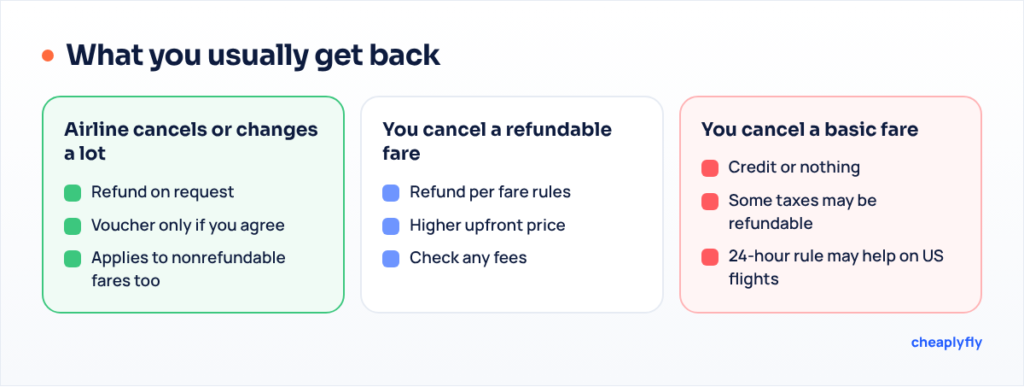
- If you cancel a nonrefundable fare, you usually get a credit or nothing, apart from some taxes in some cases. Refundable fares cost more but return cash.
- For flights to or from the US, airlines must let you hold a reservation or cancel it without penalty for 24 hours, but only if you book at least 7 days before departure.
- In the US, refunds owed by the airline go to the original form of payment, within 7 business days for credit cards and 20 calendar days for other methods.
- This is general information as of Oct 2026, not legal advice. Check the current rule for your route.
Who cancels decides almost everything
Every refund question starts with one fact: did the airline cancel or change the flight, or did you decide not to fly? When the airline fails to provide what you paid for, regulators in most major markets require a refund on request. When you change your mind, the fare rules you accepted at booking apply, and those can range from a full refund to no value at all.
A third category sits in between: schedule changes. Airlines adjust timetables months ahead, and a change can be small (a 20-minute retime) or large enough to count as a cancellation in legal terms. The size of the change decides which side of the line you are on.
Flight refund rules by situation: refund or voucher?
The table below shows what you can usually expect. “Refund” means money back to your original payment method. A voucher or credit is always something you can accept, not something the airline can impose, in the situations where a refund is owed.
| Situation | EU / UK (EU261, UK261) | US (DOT rules) | Canada (APPR) |
|---|---|---|---|
| You cancel a nonrefundable fare | Fare rules apply; often no refund except possibly some taxes | Fare rules apply; often a credit or nothing, except within the 24-hour rule | Fare rules apply |
| You cancel a refundable fare | Refund per fare rules | Refund per fare rules | Refund per fare rules |
| Airline cancels the flight | Your choice of refund within 7 days or rerouting; vouchers only with your signed agreement | Refund if you decline the alternative, whatever the cause | Refund or rebooking; for causes outside the airline’s control, a refund option if no confirmed seat within 48 hours |
| Long delay | Refund option once the delay reaches 5 hours | Refund if the delay is a significant change and you choose not to fly | Rebooking or refund options for delays within the airline’s control, under conditions |
| Major schedule change | Courts have treated a significantly earlier departure as a cancellation | Refund if you decline a significant change: over 3 hours domestic, 6 hours international, a different airport, added connections or a downgrade | Treated under the disruption rules; check the airline’s tariff |
| Paid extras not provided (seat, Wi-Fi, bag) | Check the airline’s terms | Refund of the fee for services paid for but not provided, and for significantly delayed bags | Baggage fees refunded for lost or damaged bags |
Sources: Regulation (EC) No 261/2004, the US DOT refunds page and the Canadian Transportation Agency guide. For what else is owed during a disruption, such as meals or compensation, see your rights when a flight is delayed or canceled.
The US 24-hour rule, condition by condition
The US rule, in 14 CFR 259.5, gives you a short cooling-off period after booking. It is widely misunderstood, so it helps to read it as a list of conditions. All must be met.
Conditions for the 24-hour rule
- The flight is to, from or within the United States.
- You booked at least 7 days (one week) before the scheduled departure.
- You act within 24 hours of making the reservation.
- You booked with an airline covered by the rule; US airlines and foreign airlines serving the US are covered.
- The airline offers one of two options, its choice: hold the reservation at the quoted fare for 24 hours without payment, or cancel within 24 hours without penalty.
The obligation is placed on airlines. If you booked through an online travel agency, its own cancellation policy governs; many offer a similar window, but terms vary, so read them before you pay. When you compare fares on Cheaplyfly, you complete the booking with the airline or agency you choose, and that company handles any cancellation. Our explainer on how flight search engines work shows how to see who you are booking with.
Two practical points. First, the 24 hours start when you make the reservation, not at midnight or the next business day, so note the time on your confirmation. Second, an airline that chooses the hold option instead of free cancellation does not have to refund a ticket you have already paid for, so ask which option it uses before you pay.
Refunds when the airline cancels or changes your flight
United States
Under the DOT rule that took full effect on 28 Oct 2024, refunds must be automatic once you reject the alternative or the airline offers none. They go to the original form of payment, within 7 business days for credit card purchases and 20 calendar days for other methods, and include taxes and fees. The airline cannot require you to accept a travel credit. As of Oct 2026, DOT is not enforcing the refund requirement for flights that are only renumbered without a real schedule change, and it is reviewing parts of the rule; see the July 2026 Federal Register notice.
EU and UK
When a flight is canceled, you choose between reimbursement within 7 days and rerouting. Article 7 of the regulation says payment is in cash, by bank transfer or check, or in vouchers only with your signed agreement. Once a delay reaches 5 hours, you can also choose to abandon the trip and be refunded. These rights apply whatever the cause of the cancellation.
Canada
For flights to, from or within Canada, the APPR gives a refund option when the airline cancels or delays your flight and cannot offer a suitable alternative. For disruptions outside the airline’s control, you can choose a refund if the airline cannot confirm you on a new flight leaving within 48 hours of your original departure.
Refund or voucher: weighing an offer
Sometimes an airline offers a voucher worth more than your fare, or a credit with extra flexibility. That can be a fair deal, but only if it suits your plans.
Reasons to take a voucher
- It is worth more than the cash refund on offer.
- You fly that airline often and will use it before it expires.
- It can be used for other passengers or routes you plan to book.
Reasons to insist on cash
- Vouchers expire and may exclude some fares or partner flights.
- They may only be usable by the named passenger.
- If the airline gets into financial difficulty, a voucher may be hard to use.
- Cash lets you book the best option from any airline.
Myth: A nonrefundable ticket can never be refunded.
Fact: “Nonrefundable” covers you changing your mind. If the airline cancels or makes a significant change, refund rules in the US, EU, UK and Canada still apply.
Myth: The 24-hour rule applies to every ticket.
Fact: It only applies to US flights booked at least 7 days ahead, and only with airlines. Agencies set their own policies.
Myth: Accepting a voucher at the desk is required.
Fact: Where a refund is owed, a voucher is an option you can turn down.
Getting your money back in practice
-
Request through the right company
If you booked with an agency, the refund usually flows through it, because it holds your payment. If you booked directly, ask the airline.
-
Put it in writing
Use the online refund form and state the reason: canceled flight, significant change, or the 24-hour rule. Ask for a refund to the original payment method.
-
Track the deadline
Note the date of your request. In the US, compare it with the 7-business-day or 20-calendar-day limit; in Europe, with the 7-day limit.
-
Escalate if needed
File a complaint with the regulator for your route, or contact your card issuer about a dispute if the airline does not refund a canceled service. Our guide to paying for flights with cards and currencies explains why the amount returned can differ slightly from what you paid when currencies are involved.
Groups and families face extra steps: one traveler canceling can split a shared booking, and refunds may go to whoever paid. Our guide to booking flights for families and groups covers how to set bookings up so changes are easier.
Choose the right fare before you need a refund
The cheapest way to secure a refund is often to choose the fare that includes one. Many airlines sell fare families, from basic to flexible, where only the top tier returns cash on cancellation. Our guide to fare classes and fare families explains how to read those conditions. Before you pay, compare the price difference between a basic and a flexible fare against the chance that your plans change. On the Cheaplyfly search page, open the fare details on each result to see what the airline or agency includes.
Frequently asked questions
Do flight refund rules cover taxes on a nonrefundable ticket?
It depends on the airline and the tax. Some airlines refund certain unused government taxes and airport charges on request, sometimes minus a fee. Ask the airline or agency.
Does the 24-hour rule apply to flights outside the US?
No. It applies to flights to, from or within the US. Other regions have no equivalent general rule, though some airlines offer a similar window by choice.
How long should a refund take?
In the US, 7 business days for credit cards and 20 calendar days for other payment methods. Under EU261, 7 days. Agencies can add processing time, so follow up in writing.
What if I booked through an agency and the airline canceled?
Contact the agency first; it usually holds the payment. In the US, DOT rules also place refund obligations on ticket agents for canceled or significantly changed flights.
Can I get a refund if I miss my flight?
If you miss a flight that operated as scheduled, your fare rules apply. Refundable fares may still return money; basic fares usually do not.
Are the US refund rules changing?
DOT is reviewing parts of its refund rule as of Oct 2026 and has paused enforcement for renumbered flights. Check the DOT refunds page for the current position.
Sources
- US Department of Transportation: Refunds
- eCFR: 14 CFR 259.5, Customer service plan (24-hour reservation requirement)
- Federal Register: Airline Refunds and Other Consumer Protections (Jul 2026)
- EUR-Lex: Regulation (EC) No 261/2004
- UK Civil Aviation Authority: Cancellations
- Canadian Transportation Agency: Flight delays and cancellations guide