Paying for Flights: Currency, Card Fees and Dynamic Currency Conversion
The currency you pay in can change a fare's real cost. See how conversion and card fees work, the same fare paid three ways, and how to pay safely.
When a booking page offers two prices for the same ticket, you face a real money question: pay for flights in which currency, the seller’s or your own? The answer can change the final cost more than a day’s difference in departure date. This guide explains how currency conversion, card fees and dynamic currency conversion work, then shows the same fare paid three ways.
Key takeaways
- Paying in your own currency at checkout usually means the seller or its payment provider sets the exchange rate, often with a markup built in.
- Paying in the seller’s currency lets your card issuer convert, which is often cheaper if your card has no foreign transaction fee.
- Card network rules require that you are offered a choice of currency; you should never be converted without agreeing.
- Refunds come back in the currency you paid in, so exchange rates can move between booking and refund.
- Use a credit card or a protected payment method, and always pay on the airline or agency’s secure checkout page.
Where currency costs hide in a flight booking
A flight price is set in a currency chosen by the seller, usually the airline’s or the travel agency’s local currency for that market. Your card is billed in your account currency. Somewhere between the two, someone converts, and the conversion is where the hidden cost sits.
There are three places it can happen. The seller can show and charge you in your own currency, converting first. The card network and your card issuer can convert after you pay in the seller’s currency. Or you can pay from a multi-currency account that already holds the seller’s currency, so no conversion happens at checkout at all.
The display currency on a search site is a separate matter. Comparison sites, including Cheaplyfly, may show prices converted for easy comparison, while the airline or agency charges in its own currency. Our guide to how flight search engines work explains why the price you see can shift slightly when you reach the seller’s page.
Dynamic currency conversion in plain terms
Dynamic currency conversion, or DCC, is when the merchant, or its payment provider, offers to charge you in your home currency instead of its own. It feels reassuring because you see a familiar number. The trade-off is that the merchant’s provider sets the rate, and that rate can include a markup above the rates the card networks use.
Visa’s consumer guide to dynamic currency conversion says merchants must offer a choice to accept or decline conversion and must not choose on your behalf. Mastercard’s DCC guide for merchants adds that online, a DCC option may be preselected but the cardholder must still be able to opt out and pay in the local currency.
Which currency to pay in for flights: the deciding factors
There is no answer that fits every card, so check four things before you choose.
- If your card charges no foreign transaction fee
Then paying in the seller’s currency is usually the cheaper option, because the card network’s rate tends to be close to wholesale rates.
- If your card adds a foreign transaction fee
Then compare that percentage with the markup in the checkout conversion. Either can be more expensive; work out both totals before paying.
- If you hold the seller’s currency already
Then paying from a multi-currency account or card in that currency avoids conversion at checkout entirely.
- If the site only offers your home currency
Then the conversion is built into the price. Compare the total with another seller or the airline’s own site for the same flight.
In the European Union, Regulation (EU) 2021/1230 on cross-border payments requires currency conversion charges for card payments to be shown as a percentage markup over the European Central Bank’s latest euro reference rates, disclosed before the payment is made. Other regions have their own disclosure rules; check the current rule where your card is issued.
The same fare paid three ways: an illustration
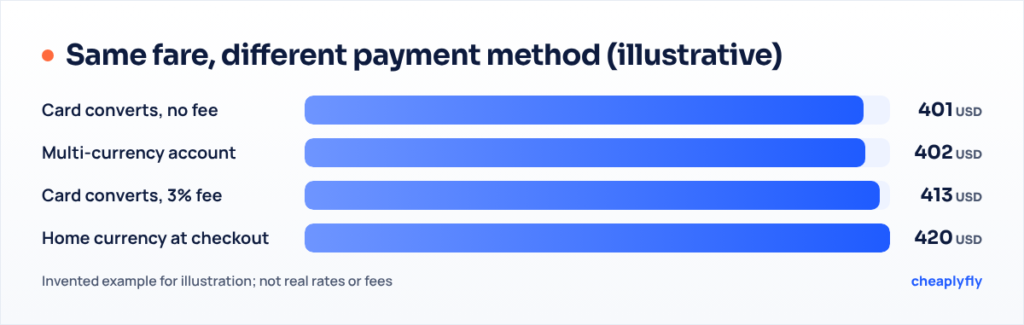
Here is how the choice plays out on one ticket. Every number below is invented for illustration only, with round figures so the method is easy to follow. Your own result depends on your card, the day’s rates and the seller.
Worked example (illustrative)
A traveler whose card is billed in USD books a fare priced at 500 units of the seller’s local currency (LC). Assume a reference rate of 1 LC = 0.80 USD, so the fare’s reference value is USD 400.
| Method (illustrative) | Who converts | Assumed cost of conversion | Approximate total |
|---|---|---|---|
| 1. Pay in LC from a multi-currency account topped up earlier | The account provider, at top-up | 0.5% at top-up | USD 402 |
| 2. Accept the home-currency price at checkout (DCC) | The seller’s payment provider | 5% markup in the rate | USD 420 |
| 3a. Pay in LC, card converts, no foreign transaction fee | Card network and issuer | Close to the network rate | About USD 401 |
| 3b. Pay in LC, card converts, card adds a 3% fee | Card network and issuer | 3% foreign transaction fee | About USD 413 |
In this illustration, the gap between the best and worst method is about USD 19 on one ticket. Across a family’s round trip, that difference multiplies. The point is not the specific numbers but the habit: compare the total in your currency for each method before you click pay.
What about refunds?
Refunds are returned in the currency you paid in, then converted again by your card issuer if needed. If the exchange rate has moved, the amount in your account can differ from what you paid. Some cards also do not reverse a foreign transaction fee on a refund. The rules on when you get money back at all are covered in flight refunds and the 24-hour rule.
Card fees, surcharges and the true checkout total
Currency is only one line. Some sellers add a payment fee for certain cards or methods, which can erase the gain from a cheaper fare. In the EU and wider European Economic Area, the revised Payment Services Directive generally bans surcharges on consumer debit and credit cards; the EU’s Your Europe guidance on pricing and payments explains that commercial cards and some three-party card schemes are not covered. Elsewhere, rules differ, so read the fee line before paying.
Include those fees when you compare sellers, alongside bags and seats. The guide to the true cost of a cheap fare shows how to build a like-for-like total, and multi-city or one-way combinations may involve several payments in different currencies, as explained in one-way, round-trip or multi-city.
Payment safety: protect the booking and your card
Flights are expensive, paid well in advance and attractive to fraudsters. A few habits keep both the money and the booking safe.
Strong customer authentication is one built-in layer. Under the EU’s revised Payment Services Directive, which the European Central Bank summarizes in its PSD2 explainer, online payments generally need two independent checks, such as a password and a code on your phone. Many issuers elsewhere use similar one-time codes or app approvals.
Payment safety checklist
- Pay only on the airline or agency’s own checkout page, reached from a search result or typed address, never from a link in an unexpected message.
- Check the address bar for the seller’s correct domain and a secure connection before entering card details.
- Prefer a credit card or a payment method with purchase protection over a bank transfer.
- Choose the currency yourself; decline home-currency conversion unless you have compared it.
- Read the final total, including any payment fee, before confirming.
- Save the confirmation, the airline booking reference and the e-ticket number.
- Check your statement soon after booking and report anything unexpected quickly.
If something goes wrong with the charge
Contact the seller first with your booking reference. If that fails, card issuers have dispute processes with deadlines. In the United States, for example, the Consumer Financial Protection Bureau explains how to dispute a charge on a credit card bill, including sending written notice within 60 days of the statement that first showed the error. Other countries have their own rules, so ask your issuer about the time limit.
Remember that Cheaplyfly helps you search and compare; the payment itself happens on the airline’s or agency’s site, under their terms. When you are ready, search your trip, open the offer you prefer and decide how to pay for flights in which currency with the totals in front of you.
Frequently asked questions
Should I pay for flights in which currency, mine or the seller’s?
Often the seller’s, if your card has no foreign transaction fee, because the card network rate is usually closer to the market rate than a checkout conversion. Compare both totals to be sure.
What is dynamic currency conversion?
It is when the merchant offers to charge you in your home currency and sets the exchange rate itself. It is optional, and card network rules say you must be given the choice.
Why did my card statement show a different amount from the booking page?
If you paid in a foreign currency, your issuer converted it at its rate on the processing date and may have added a foreign transaction fee. Displayed prices on comparison sites can also be converted estimates.
Is it safer to pay by credit card or debit card?
Credit cards often give stronger dispute rights and keep fraud away from your bank balance, but protections vary by country and issuer. Check your card terms.
Can a seller charge me extra for paying by card?
It depends on where the seller and your card are based. In the EU, surcharges on most consumer cards are banned; in other regions, card fees may be allowed if disclosed.
Does Cheaplyfly take my payment?
No. Cheaplyfly shows and compares flights. You pay the airline or travel agency directly on their checkout page.
Sources
- Visa: What is Dynamic Currency Conversion?
- Mastercard: Dynamic Currency Conversion guide (merchant version, 2025)
- EUR-Lex: Regulation (EU) 2021/1230 on cross-border payments
- Your Europe: Pricing, payments and price discrimination FAQ
- European Central Bank: The revised Payment Services Directive (PSD2)
- CFPB: How do I dispute a charge on my credit card bill?