Overbooking and Denied Boarding: Your Options When a Flight Is Full
Why flights are overbooked, the difference between volunteering and being bumped, and what to ask at the gate.

When a flight has more passengers than seats, the airline has to decide who stays behind, and the rules on denied boarding compensation decide what those passengers get. Knowing the difference between volunteering and being bumped against your will, and what to ask at the gate, can be worth a lot of money and a much better onward flight.
Key takeaways
- Airlines sell more seats than they have on some flights because a share of passengers do not show up. When everyone does, someone is left behind.
- In the EU, UK and US, the airline must ask for volunteers before bumping anyone involuntarily.
- Volunteers negotiate their own deal. Passengers bumped against their will get fixed amounts set by law in many regions.
- Checking in on time and being at the gate when required protects your rights. Late passengers can lose them.
- Amounts and rules below are as of Oct 2026. Check the regulator’s current page before you rely on them.
Why flights are overbooked
Airlines know from experience that some booked passengers will not turn up: plans change, connections are missed and some tickets allow a no-show. To avoid flying empty seats, airlines may sell slightly more tickets than the aircraft holds. Most of the time the numbers work out. When they do not, the airline has an oversold flight and has to deny boarding to someone.
Overbooking is not the only cause. A smaller aircraft may be swapped in, or weight limits on a hot day may reduce the number of passengers who can fly. The reason matters, because some rules treat safety-related or operational changes differently from commercial overbooking.
Cheaplyfly helps you compare flights; you book and pay with the airline or travel agency. If you are denied boarding, the operating airline is responsible for rebooking you and for any compensation owed.
Volunteer or involuntary: the two paths
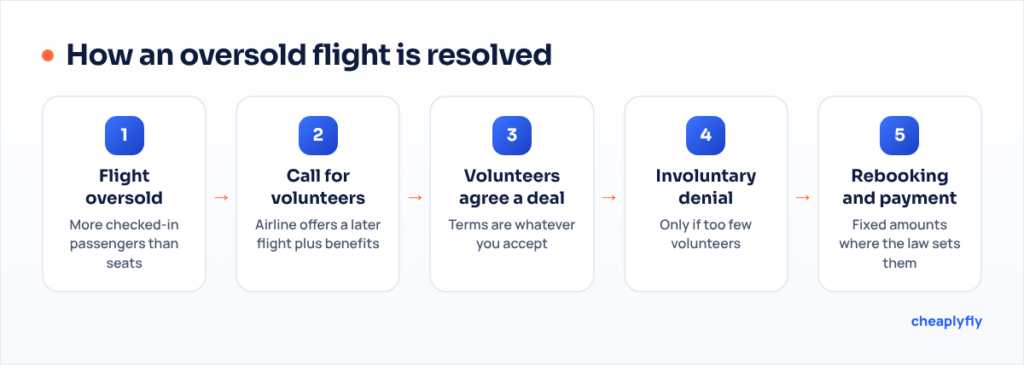
Everything depends on which path you take. A volunteer agrees to give up a seat in return for benefits offered by the airline. An involuntary passenger is refused boarding without agreeing. The flow below shows how the process usually runs at the gate.
- Before boarding
The airline sees the flight is oversold and announces it is looking for volunteers, often with an offer of a later flight plus a payment or travel credit.
- Negotiation
Volunteers accept, decline or negotiate. The offer may rise if not enough people come forward. There is no legal ceiling on what an airline can offer a volunteer.
- Involuntary denial
If there are still too many passengers, the airline selects who stays behind using its published boarding priority rules.
- Rebooking and payment
Bumped passengers are rebooked or refunded and, where the law requires it, receive fixed compensation and a written explanation of their rights.
What changes if you volunteer
Volunteering is a deal, and its terms are whatever you agree. That can be generous, but the fixed legal amounts for involuntary passengers generally do not apply on top. In the EU, volunteers still keep the right to choose a refund or rerouting under Article 4 of Regulation (EC) No 261/2004. In the UK, the Civil Aviation Authority notes that volunteers agree compensation with the airline, which might be cash or vouchers.
Denied boarding compensation by region
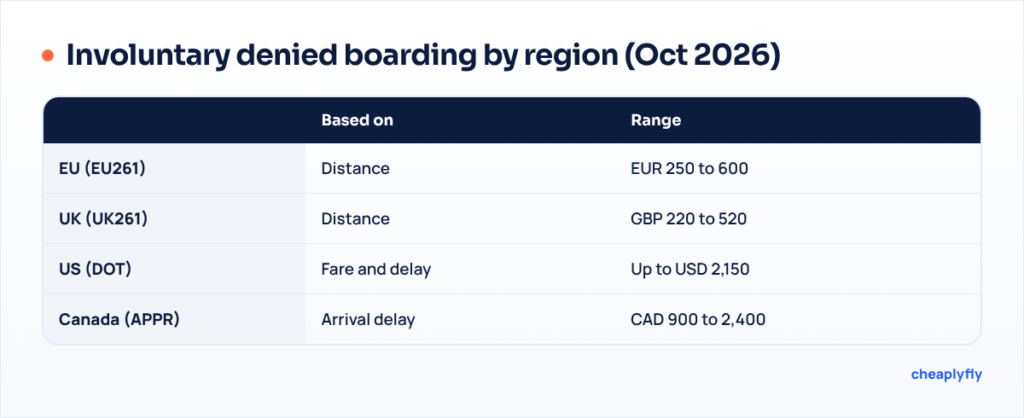
Rules differ around the world, and many countries have none at all. These are the best-known examples. They apply to involuntary denial for reasons such as overbooking, and each has conditions and exceptions, so treat this as an overview.
European Union (EU261)
For flights departing the EU, and flights into the EU on EU airlines, Article 7 sets compensation by distance: EUR 250 for flights of 1,500 km or less, EUR 400 for flights within the EU over 1,500 km and other flights between 1,500 and 3,500 km, and EUR 600 for longer flights. The amount can be halved if the airline reroutes you and you arrive within 2, 3 or 4 hours of the original time, depending on distance. You also get the choice of refund or rerouting and care such as meals and a hotel if needed, as the Your Europe guide explains.
A revision of these rules was provisionally agreed in June 2026 and still needs formal approval, according to the European Commission. Check the current status before relying on any amount.
United Kingdom (UK261)
The UK kept the EU rules in its own law, with amounts in pounds. According to the CAA, a passenger bumped without agreeing, who checked in on time, can claim GBP 220 for flights under 1,500 km, GBP 350 for 1,500 to 3,500 km and GBP 520 for longer flights. These fall to GBP 110, GBP 175 and GBP 260 if you arrive less than 2, 3 or 4 hours late respectively. You can also choose a refund within 7 days or rerouting.
United States (DOT)
US rules, in 14 CFR 250.5, base compensation on the one-way fare and on how late the substitute flight gets you there:
| Arrival delay vs original plan | Domestic flights | International flights from the US |
|---|---|---|
| Under 1 hour | No compensation | No compensation |
| 1 to 2 hours (domestic) / 1 to 4 hours (international) | 200% of the one-way fare, up to USD 1,075 | 200% of the one-way fare, up to USD 1,075 |
| Over 2 hours (domestic) / over 4 hours (international) | 400% of the one-way fare, up to USD 2,150 | 400% of the one-way fare, up to USD 2,150 |
Those limits took effect in January 2025 after the October 2024 inflation adjustment, and the rule provides for a review every two years. Eligible passengers are entitled to cash or a check, not only a voucher, and must receive a written statement explaining their rights. Airlines may pay more than the limits.
Canada (APPR)
Canada’s Air Passenger Protection Regulations set compensation by arrival delay when the denial is within the airline’s control and not required for safety: CAD 900 for under 6 hours, CAD 1,800 for 6 to under 9 hours and CAD 2,400 for 9 hours or more. The Canadian Transportation Agency says the airline must pay within 48 hours.
When you may get nothing
Every regime has exceptions. The common ones are worth knowing before you travel, because they are easy to avoid:
- Late check-in or arrival at the gate. US rules exclude passengers who did not meet check-in and ticketing requirements, and the UK requires that you checked in on time. Read our guide to online check-in and boarding passes to know each airline’s deadlines.
- Reasonable grounds to refuse carriage. The EU rule excludes refusals for health, safety, security or inadequate travel documents.
- Smaller aircraft for safety or operational reasons. US rules list this as an exception; Canada’s rules link compensation to causes within the airline’s control.
- Flight cancellations. A canceled flight is not denied boarding; different rules apply. See your rights when a flight is delayed or canceled.
What to ask at the gate
Gate conversations move fast. Having questions ready helps you stay calm and get a fair outcome, whether you volunteer or not. Use this script as a starting point and adapt it to your situation.
Gate script for volunteers
- “Which flight would you rebook me on, and is that seat confirmed, not standby?”
- “What time does it arrive at my final destination?”
- “Is the offer cash, a voucher or travel credit? When does it expire, and what can it be used for?”
- “Will you cover meals, a hotel and transport if the new flight is tomorrow?”
- “Will my checked bag be moved to the new flight?”
- “Can I have the offer and the new booking in writing before I give up my seat?”
Gate script if you are bumped involuntarily
- “Am I being denied boarding involuntarily? Please note that I did not volunteer.”
- “What compensation is owed under the rules for this flight, and can I have it in writing?”
- “What are my options for rerouting or a refund?”
- “What care will you provide while I wait, such as meals or a hotel?”
- “Can I have your written notice of passenger rights?”
Do not accept a voucher in place of cash compensation without reading its terms. In the US, involuntarily bumped passengers who qualify are entitled to cash or a check, and in the EU vouchers require your signed agreement.
If you have a connection later in the trip, ask the agent to protect it before you leave the desk. Our guide to missed connections explains what to do if the new flight breaks the rest of your journey.
After the flight: claiming what you are owed
If you did not receive compensation at the airport, claim it from the operating airline in writing. Keep your boarding pass or booking confirmation, any written notice from the gate and receipts for meals or transport. Send a short message naming the flight, the date, the fact that you were denied boarding against your will and the rule you rely on.
If you decide not to travel at all after being bumped, ask for a refund. Our guide to refunds and cancellations explains how refunds reach your original payment method. If the airline does not respond, regulators and national enforcement bodies in many regions accept complaints, and the help center explains who to contact about a booking you made after searching on Cheaplyfly.
Frequently asked questions
Is overbooking legal?
In many regions it is legal, as long as the airline follows the rules: asking for volunteers first and paying denied boarding compensation where the law requires it.
How does an airline choose who gets bumped?
Airlines publish boarding priority rules in their conditions of carriage. Factors can include fare type, check-in time, status and special needs. Checking in early can reduce your risk.
Should I volunteer?
If your plans are flexible and the offer includes a confirmed seat on a reasonable flight plus fair compensation, it can be a good deal. Get the terms in writing first.
Do I still get a refund for unused parts of my ticket?
If you do not travel after being bumped, you can usually ask for a refund of the unused part. Rules vary by region, so check with the airline and regulator.
Does denied boarding compensation apply on every flight?
No. It depends on the route, the airline and local law. Many countries have no fixed scheme, so the airline’s own conditions of carriage apply.
Can the airline give me a voucher instead of cash?
A voucher is an option you can accept, but in the US and EU you are not required to take one in place of cash compensation for involuntary denial.
Sources
- EUR-Lex: Regulation (EC) No 261/2004 on air passenger rights
- Your Europe: Air passenger rights
- European Commission: Agreement on revised air passenger rights (Jun 2026)
- UK Civil Aviation Authority: Denied boarding
- eCFR: 14 CFR 250.5, Amount of denied boarding compensation
- Federal Register: Periodic revisions to denied boarding compensation limits (Oct 2024)
- Canadian Transportation Agency: Bumping (denied boarding)