Special Assistance When Flying: Wheelchairs, Hidden Disabilities and How to Ask
Wheelchair help, guided support and hidden-disability assistance are widely available. Here is when and how to ask, and what the rules say.
Special assistance flights run most smoothly when the airline knows what you need before you arrive. Wheelchair help, guided support through the airport, help for people with hidden disabilities and space for mobility equipment are widely available, and in many regions the law says they must be free.
Key takeaways
- Ask for assistance when you book, or at least 48 hours before departure, through the airline or the company you booked with.
- In the EU and UK, assistance for disabled passengers and people with reduced mobility is free; in the US, the Air Carrier Access Act sets airline duties.
- Late requests should still be met where reasonably possible, so ask even on the day.
- Hidden disabilities count. Many airports offer the Hidden Disabilities Sunflower lanyard as an optional, discreet signal.
- Keep a short written summary of your needs, and the booking reference of your assistance request, with your boarding pass.
What special assistance covers
Help on special assistance flights is broader than a wheelchair. Airports and airlines help people who have a physical disability, reduced mobility because of age or injury, sight or hearing loss, learning disabilities, or non-visible conditions such as autism, dementia, anxiety or chronic pain. The UK Civil Aviation Authority’s guide to accessing help and support lists hidden disabilities alongside physical ones.
Common types of help include:
- A wheelchair, or a staff member to guide you, from check-in or a designated arrival point to the aircraft seat, and the reverse on arrival.
- Help through security, passport control, connections and baggage reclaim.
- Boarding by lift, ambulift or aisle chair where there is no jet bridge.
- Carriage of your own wheelchair, mobility scooter or other mobility aids.
- Quiet routes, quiet waiting areas or extra time at the checkpoint.
- Seating that meets your needs, such as a seat with a movable armrest.
How to request special assistance for flights: a three-stage flow
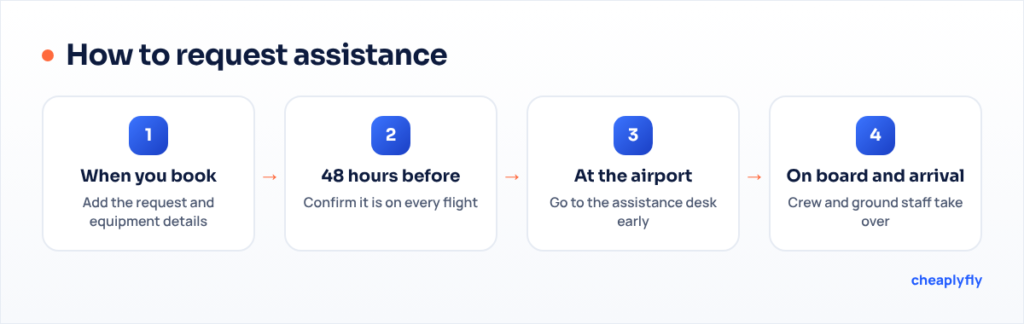
The same three stages apply almost everywhere. The earlier you act, the more options the airline and airport have.
-
When you book
Tell the company you book with what you need. Airlines and agencies usually have a “special assistance” option in the booking flow or in “manage booking”, and a phone line for complex needs. If you compare flights on Cheaplyfly, you complete the booking with the airline or travel agency, so add the request there and note the confirmation. Mention mobility aid details (type, size, weight, battery type), any medical equipment and whether you travel with an assistance dog.
-
At least 48 hours before
Confirm the request is on your booking for every flight, including connections and the return. Under EU rules, notice given at least 48 hours ahead must be passed to the airports and the operating airline at least 36 hours before departure. Contact the airline again if anything is missing, and ask whether your equipment needs special handling or forms.
-
At the airport
Go to the airport’s assistance desk or a designated call point. Many airports ask you to arrive earlier than other passengers. Keep your phone charged and tell staff about any change in what you need. If help does not arrive, ask for a supervisor, and on a US flight ask for the airline’s Complaints Resolution Official.
Write a short card or phone note: what help you need, what you can do yourself, how to move your wheelchair safely and its battery type. Hand it over at each stage so you do not have to explain everything again at every desk.
Your rights by region: three examples
Rules depend on where you fly from, where you fly to and the airline. Here are three well-documented examples; other regions have their own rules, and some countries provide little or no assistance, so check before you travel.
European Union
Regulation (EC) No 1107/2006 gives disabled people and people with reduced mobility the right to assistance at EU airports. Airlines and agents must accept requests at all points of sale, and the full assistance obligation applies where the airline was told at least 48 hours before the published departure time. If notice is late, the airport must still make all reasonable efforts to help. The EU’s Your Europe page explains that a recognized assistance dog, medical equipment and up to two pieces of mobility equipment travel free.
United Kingdom
According to the UK Civil Aviation Authority, passengers with a disability or reduced mobility are legally entitled to free assistance when flying from a UK airport on any airline, or to a UK airport on a UK or EU airline. The CAA advises telling the airline at least 48 hours before the flight and says airports can provide optional identification, such as lanyards, for people with hidden disabilities.
United States
The Air Carrier Access Act and its regulation, 14 CFR Part 382, prohibit disability discrimination by airlines. Airlines may not require advance notice simply because a passenger with a disability is traveling. They may ask for up to 48 hours’ notice, and earlier check-in, for a defined list of services such as using a ventilator, respirator, CPAP machine or portable oxygen concentrator on board. Airlines that offer their own in-flight medical oxygen may ask for up to 72 hours’ notice on international flights. The US Department of Transportation’s wheelchair and guided assistance page explains that airlines must provide prompt help to passengers who need it, including at connections, and that every airline must make a Complaints Resolution Official available.
For security screening in the US, the TSA’s TSA Cares service recommends contacting it at least 72 hours before travel to arrange checkpoint support. Assistance through the airport itself is the airline’s job.
| Region (example) | Main rule | Notice to give | If something goes wrong |
|---|---|---|---|
| European Union | Regulation (EC) 1107/2006 | At booking, and at least 48 hours before departure | Airline or airport, then the national enforcement body |
| United Kingdom | UK law enforced by the CAA | At least 48 hours before, as advised by the CAA | Airline or airport, then the CAA |
| United States | Air Carrier Access Act, 14 CFR Part 382 | Usually none; up to 48 hours for listed services | Complaints Resolution Official, then the US DOT |
Hidden disabilities and the Sunflower lanyard
Not every disability is visible. The Hidden Disabilities Sunflower is a green lanyard (or pin or card) printed with sunflowers. Wearing it tells trained staff that you, or someone with you, may need extra help, time or patience, without having to explain why. The scheme started at London Gatwick Airport in 2016 and is now recognized by many airports and some airlines around the world.
Wearing the Sunflower is optional, and it does not replace an assistance request. Think of it as a signal at busy moments, such as the security line or the gate, while your booking still holds the details of the help you need. Many participating airports hand lanyards out free at their assistance or information desks; check your airport’s accessibility page.
Wheelchairs, equipment and medicines
Mobility equipment needs the most preparation. Give the airline the dimensions, weight and battery type in advance, and attach simple handling instructions to the chair. Removable parts, such as cushions and joysticks, are safer in the cabin with you. Lithium batteries follow safety rules that the airline will explain.
Medicines and medical devices should travel in your cabin bag with prescriptions or a doctor’s letter. Our guide to flying with medication explains documents and liquid exceptions, and our airport security tips cover how to ask for private screening or a pat-down.
Seating also matters. Seats with movable armrests make transfers easier, and seats near the front shorten the distance to the door. Airlines generally do not seat passengers who would need help in an evacuation in exit rows. Our guide to choosing the best airplane seat explains how seat maps work.
Before-you-fly assistance checklist
- Assistance request on the booking for every flight, including the return.
- Confirmation number or email for the request saved on your phone.
- Mobility equipment details sent: size, weight, battery type.
- Medicines and prescriptions in your cabin bag.
- A note of your needs to show staff at each stage.
- Sunflower lanyard collected, if you want to use one.
- Airport assistance desk location and recommended arrival time checked.
When assistance fails or flights are disrupted
If assistance is late or missing, ask for a supervisor at once and make a note of times and names. Complain in writing to the airline (and, in the EU or UK, to the airport, which is responsible for assistance in the terminal). If your wheelchair is damaged, report it before leaving the airport. If a flight is delayed or canceled, you keep your rights to assistance on the new flight, and our guide to flight delay and cancellation rights explains rebooking, care and compensation. Special assistance flights are a right in many regions, not a favor, so ask clearly and early.
Frequently asked questions
Do I have to pay for wheelchair assistance at the airport?
In the EU and UK, assistance for disabled passengers and people with reduced mobility is free. In the US, airlines must provide wheelchair assistance to passengers who need it. In other regions, rules vary, so ask the airline.
How far in advance should I request assistance?
When you book, and no later than 48 hours before departure. Later requests should still be met where reasonably possible, but early notice gives you the most reliable help.
Can I ask for help if my disability is not visible?
Yes. Hidden disabilities such as autism, dementia, anxiety or hearing loss are covered by airport assistance services in many regions. The Sunflower lanyard is an optional way to signal it.
Can I bring my own wheelchair?
Usually yes. Give the airline its size, weight and battery type in advance. Under EU rules, up to two pieces of mobility equipment travel free.
What is a Complaints Resolution Official?
In the US, every airline must make a Complaints Resolution Official available, in person or by phone, to resolve disability-related problems on the spot.
Does assistance continue on a connecting flight?
It should, if the request is on the whole booking. Confirm each flight, and allow a longer connection if you need help transferring between gates.
Sources
- EUR-Lex: Regulation (EC) No 1107/2006
- Your Europe: Passenger rights for people with disabilities or reduced mobility
- UK Civil Aviation Authority: How to access help and support
- eCFR: 14 CFR Part 382, Nondiscrimination on the basis of disability in air travel
- US Department of Transportation: Wheelchair and guided assistance
- TSA: Request for TSA Cares assistance
- Hidden Disabilities Sunflower: Who the Sunflower is for