Nearby Airports and Alternative Routes: Finding the Fares Others Miss
The cheapest fare is not always the cheapest trip. Learn a radius method and a total-trip-cost check to judge nearby airports and alternative routes.

If you have ever typed “alternative airports cheap flights” into a search bar, you already suspect the obvious airport is not always the best deal. Flying from a second airport, landing in a neighboring city or routing through a different hub can cut the fare, but only a full door-to-door count tells you whether the saving is real. This guide shows you how to run that count and how to widen your search without wasting a weekend on it.
Key takeaways
- Many big cities are served by several airports, and fares between them can differ a lot on the same day.
- Compare the total trip cost, not the ticket: add ground transport, bags, extra nights and the value of your time.
- Use a radius method: start at one hour from home, then two, then consider a rail-and-fly or open-jaw plan.
- Splitting a trip into separate tickets to reach a cheaper hub adds risk if a flight is late.
- Your passenger rights can change with the departure airport, so check which rules apply before you switch.
Why alternative airports cheap flights often hide in plain sight
Airlines price each route on its own demand and competition. A main hub may be dominated by full-service carriers with higher fares, while a smaller airport an hour away is a base for low-cost airlines that price aggressively to fill seats. The result is that two airports serving the same region can show very different prices for the same dates.
There is also a coding reason. The aviation industry uses metropolitan “city codes” that group several airports serving one area, for example LON for the London airports or PAR for Paris. You can look up airport and city codes in the IATA airline and airport code search. Searching by a city code shows more options at once, but not every search tool groups the same airports, and a smaller airport just across a border is never inside a city code.
That is why the fares other travelers miss are usually not secret. They sit one tab over, at an airport the traveler did not think to type. If you want the wider toolkit around this tactic, our guide on how to find cheap flights covers dates, alerts and fare types too.
Three kinds of “alternative”
- Secondary airports in the same city area. Often served by low-cost carriers, sometimes much farther from the center than the name suggests.
- Airports in a neighboring city or country. A short train or bus ride away, sometimes with a much bigger choice of long-haul flights.
- Alternative routes. Flying into one city and out of another, connecting through a different hub, or using a train for one leg.
The radius method: a planning routine that scales
Searching every airport within driving distance quickly gets messy. A radius method keeps it orderly: you widen the circle only when the closer options have been checked, and you stop as soon as the extra travel stops paying for itself.
-
Draw ring one: about one hour from home
List every airport you can reach in roughly an hour by car, train or bus. Search them all for your dates. This ring usually costs little extra in time or money, so any saving here is close to pure gain.
-
Draw ring two: about two to three hours
Add airports that need a longer train ride or drive. Note the travel time, the earliest public transport of the day and whether you would need a hotel the night before an early flight.
-
Do the same at the destination
Repeat both rings around where you are going. Landing at a secondary airport with a good rail link can beat a main airport with a slow, expensive transfer.
-
Test open-jaw and mixed routes
Try flying into one city and home from another, or combining a flight with a train. Our comparison of one-way, round-trip and multi-city tickets explains when a multi-city search prices this better than two one-ways.
-
Score every option on total trip cost
Put each candidate into the table in the next section. Keep only the options that win after ground transport, bags and time are added.
Write down the last bus or train of the evening at each arrival airport. A cheap flight that lands after the last connection can force a taxi or a hotel, which often erases the saving.
On Cheaplyfly, the explore page is a quick way to see which destinations and airports price well from a starting point before you commit to a detailed comparison.
Total trip cost: the comparison that decides it
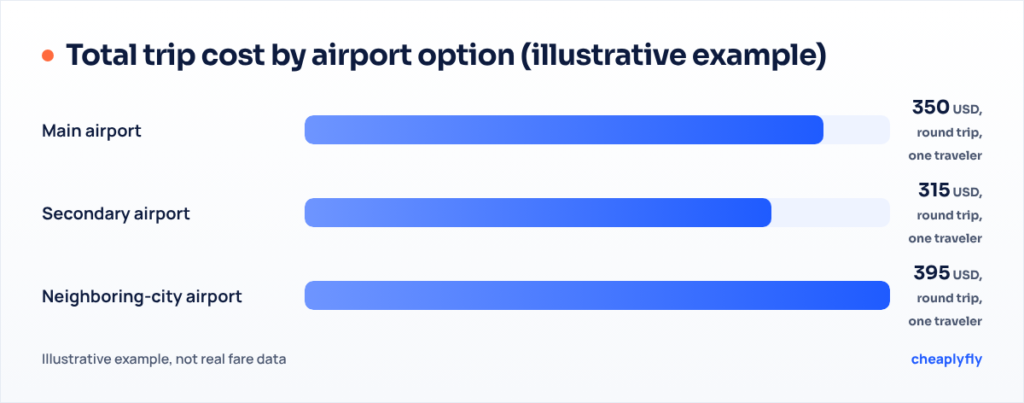
A fare is only one line of the bill. The table below compares three airport options for the same trip, using made-up but realistic numbers. It is an illustrative example in USD, not real data, and your own figures will differ.
| Cost line (illustrative example, USD, one traveler, round trip) | Main airport | Secondary airport, same city area | Airport in neighboring city |
|---|---|---|---|
| Airfare | 320 | 190 | 210 |
| Checked bag both ways | Included | 70 | Included |
| Ground transport to and from the airport | 30 | 55 | 90 |
| Parking or overnight hotel | 0 | 0 | 95 (early departure) |
| Extra door-to-door time | Baseline | +1.5 hours | +4 hours |
| Total money cost | 350 | 315 | 395 |
| Saving versus main airport | n/a | 35, for 1.5 extra hours | None, costs 45 more |
In this example the neighboring-city airport looks cheapest on fare alone but becomes the most expensive option once the hotel and transfer are counted. The secondary airport still wins, yet the saving is modest. Whether 35 is worth an extra hour and a half is a personal call, which is exactly why the time line belongs in the table.
Bags deserve special attention, because low-cost carriers often price them separately. Our breakdown of what low-cost airlines include shows what to check, and the guide to the true cost of a cheap fare walks through seat, bag and payment fees line by line.
Put a value on your time
Give each extra hour a price before you start, so the decision is not made by tiredness at midnight. Some travelers use a rough hourly figure; others simply set a rule such as “I will add up to two hours only if I save enough to cover a nice dinner”. The point is to decide the rule once and apply it to every option.
Alternative routes: hubs, open-jaws and rail links
Changing airports is only half of the toolkit. Changing the route can matter just as much, especially on long-haul trips where a different connecting hub may be priced very differently.
A different hub on one ticket
Searching with a flexible connection point can show itineraries through hubs you would not have chosen. When the whole trip is on one ticket, the airlines on that ticket generally rebook you if a delay makes you miss the connection; check the conditions of carriage for the details.
Open-jaw trips
Flying into one city and home from another saves you backtracking. It works well for touring trips, and the ground leg in between is often a scenic train ride rather than a wasted day.
Rail for the short leg
On short distances, a train to a bigger airport can replace a short feeder flight. It can also reduce the emissions of the trip, a point covered in our guide to more sustainable flying choices.
The risk of building your own connection
Reaching a cheap hub on a separate ticket is a common way to save, but the two tickets are not linked. If the first flight is late and you miss the second, the second airline usually has no duty to help, and you may need to buy a new ticket. Read our full guide to self-transfer flights and their risks before you rely on one, and leave generous buffers if you do.
Separate tickets also mean separate baggage. You may need to collect and re-check bags, and possibly pass through immigration, between flights. Check the transit and entry rules for the connecting country before you book.
How the departure airport can change your rights
Your protections after a delay or cancellation depend on regional rules, and those rules are often tied to where the flight departs. As one regional example, the European Union’s air passenger rights regulation, Regulation (EC) No 261/2004, covers flights departing from an airport in the EU, and flights arriving in the EU when operated by an EU airline. Moving your departure a short distance across a border can therefore move you in or out of that scheme.
Other regions have their own frameworks, and rules change over time, so check the current rule for the airport and airline you are considering. It is one more line to weigh, alongside price and time, when you compare options.
A quick decision guide
- If the alternative airport is within an hour and the saving covers transport
Then it is usually worth booking, provided the bag rules suit your trip.
- If the alternative needs an extra hotel night
Then add the hotel and meals to the table; the saving often disappears on a short trip but can survive on an expensive long-haul fare.
- If the cheap option relies on two separate tickets
Then only book with a long buffer, carry-on luggage and a backup plan for a missed connection.
- If you are traveling as a family or group
Then multiply transport and bag costs by every traveler. Group costs scale faster than a single fare difference suggests.
- If the arrival airport has poor late-night transport
Then prefer an earlier flight even at a slightly higher fare, or price in a taxi.
Making alternative airports cheap flights a habit
The method works best when it becomes routine rather than a one-off effort. Keep a short note of the airports in your two rings, their typical transfer cost and the last connection home. Next time, the comparison takes minutes instead of an evening.
Combine it with flexible dates and price alerts and the gains compound: a cheaper airport on a cheaper day beats either tactic alone. When you are ready to compare real fares, start a search on Cheaplyfly with your nearby airports in mind and use the flight search to check each one side by side. You then book with the airline or travel agency you choose on their own site.
Finally, remember emissions are part of the trip too. If you want to compare the footprint of two routings, the ICAO Carbon Emissions Calculator gives a consistent estimate of CO2 per passenger.
Frequently asked questions
Are secondary airports always cheaper?
No. They are often bases for low-cost airlines with lower base fares, but bag fees, longer transfers and fewer flights per day can cancel the saving. Compare the total trip cost for your dates before you decide.
How far is it worth traveling to a cheaper airport?
There is no fixed distance. Set a value for your time, add transport, parking or a hotel, and compare the totals. Short trips rarely justify a long transfer; expensive long-haul fares sometimes do.
What is a city code in flight search?
It is a code that groups several airports serving one metropolitan area, such as LON for London. Searching by city code shows several airports at once, but it will not include airports in a neighboring city or country.
Is it safe to book a separate ticket to reach a cheaper hub?
It can work, but the tickets are not protected as one journey. If your first flight is late, the second airline usually will not rebook you for free. Leave a long buffer and travel light.
Can flying from a different airport change my compensation rights?
Yes, potentially. Many passenger rights schemes depend on the departure airport or the airline. For example, the EU rules cover departures from EU airports. Check the current rules that apply to your chosen flight.
Should I include the cost of my time?
It helps. Without a time value, a small saving can look attractive at booking and feel poor on travel day. Even a rough personal figure makes comparisons fairer.