Flight Price Alerts Explained: How They Work and When to Book
How fare alerts work, a setup checklist, and simple if/then rules for deciding what to do when one fires.

Flight price alerts watch a route for you and tell you when the fare moves, so you do not have to search every day. Used well, they turn booking into a calm decision instead of a guessing game. This guide explains how alerts work, how to set one up properly, and exactly what to do when one lands in your inbox.
Key takeaways
- An alert tracks a route and dates and notifies you when the price changes or drops below a level you choose.
- The price in an alert is a signal, not a quote. Always open a live search to confirm the fare and what it includes.
- Set a target price before the alert fires, so you know in advance whether you will book.
- Check the fare type, bags and change rules before you act on a drop. A lower price can mean fewer inclusions.
- Booking protections such as the US 24-hour rule or a paid fare hold can give you time to decide.
How flight price alerts work
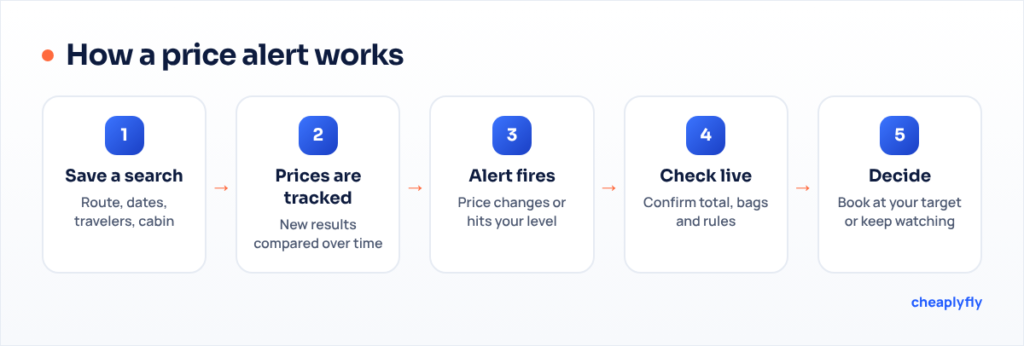
When you create an alert, you save a search: origin, destination, dates or a date range, number of travelers and sometimes cabin. The service then checks prices for that search over time and compares each new result with the last one. When the price changes in a way that matches your settings, you get a notification.
Most alerts fall into three types:
- Fixed-date alerts track one set of travel dates. They suit trips where the dates are already decided.
- Flexible alerts track a range of dates or a whole month and report the lowest price in that range. They suit trips where you can move by a few days.
- Route alerts track a route with no fixed dates and flag unusually low fares. They suit travelers looking for inspiration.
The prices behind an alert come from searches, so they can be a little out of date by the time you read the message. Fares change because airlines sell seats in price levels, and when a level sells out, the price steps up. That is why a good alert is something you act on promptly, but not blindly.
Setting up an alert that is actually useful
A badly set alert sends either too many messages or the wrong ones. A few minutes of setup makes every notification meaningful. Start by looking at the route on a price calendar to learn the usual range; our guide to reading a flight price calendar shows how.
Alert setup checklist
- Enter the correct airports, including nearby alternatives if you would genuinely use them.
- Choose fixed dates or a date range that matches your real flexibility.
- Set the right number of travelers, since price levels can differ for a group.
- Pick the cabin you will actually book.
- Write down a target price based on the normal range and your budget.
- Decide what the price must include for you, such as a checked bag.
- Note the latest date you are willing to wait before booking anyway.
That last point matters. Alerts can make it tempting to wait for an even lower number, while on busy routes the cheaper fare levels may close as departure approaches. Our guide on the best time to book flights shows a typical booking window so you can set a sensible deadline. You can create an alert from the price alerts page.
The alert fired, now what?
When a notification arrives, run through these rules in order. They are written so you can decide in a couple of minutes.
- If the price is at or below your target
Then open a live search straight away. If the live total, with the bags and seats you need, is still within your target, book it. Waiting for a further small drop risks losing this one.
- If the live price is higher than the alert said
Then the cheaper fare has probably sold out or the alert used an older price. Do not chase it. Keep the alert running and check the other dates in your range.
- If the price dropped but is still above your target
Then note it as a sign the route is moving and keep watching. If you are close to your booking deadline, compare it with the price you have seen most often and decide whether it is good enough.
- If the cheaper price comes with a different fare type
Then compare like for like. A lower fare may exclude bags, seat choice or changes. Our guide to fare classes and fare families explains what each level usually includes.
- If the drop is on different dates or airports
Then check that the new option still works: arrival time, extra accommodation, transfer cost and time off. Only switch if the total trip is cheaper.
- If the price rose and you are near your deadline
Then stop waiting. Book the best total option available, and use any free cancellation window or fare hold if you want a little more certainty.
- If you have already booked and the price falls
Then contact the airline or travel agency you booked with and ask what your fare allows. Some airlines will refund the difference or give a credit, while many basic fares allow nothing.
Reading the price in an alert correctly
An alert usually shows a single number. Before you trust it, check four things on the live result.
What the fare includes
Airlines sell the same seat under different fare types with different rules. The cheapest one may not include a checked bag, seat selection or any changes. Compare the price with the inclusions you set in your checklist.
Taxes and mandatory charges
Rules on price display vary by region. In the European Union, Regulation (EC) No 1008/2008 requires the final price, including unavoidable taxes, charges and fees, to be shown at all times, with optional extras offered on an opt-in basis. In the United States, the Department of Transportation requires advertised fares to include government taxes and mandatory carrier charges. Optional extras still come on top.
Per person or per booking
Check whether the alert price is for one traveler or the whole group, and whether the live fare is the same for every seat you need.
Currency
If the fare is shown in a currency other than your card’s, allow for the conversion and any foreign transaction fee your card provider charges.
Tools that buy you time after an alert
Sometimes you need a day to confirm plans before paying. Several protections can help, depending on where and how you book.
- The US 24-hour requirement. For tickets bought at least seven days before departure, airlines must either hold the reservation at the quoted fare for 24 hours without payment or allow cancellation within 24 hours for a full refund. The DOT guidance notes it does not apply to tickets from third-party agents, so check the agency’s policy.
- Airline fare holds. Some airlines offer their own holds. American Airlines offers a free hold of up to 24 hours on select flights booked at least seven days ahead, and British Airways offers a paid hold of up to 72 hours. Check current fees and conditions, as of Oct 2026.
- Price checks after booking. The DOT suggests checking the fare after you buy, because some airlines will refund the difference if the same fare drops, but only if you ask.
Cheaplyfly helps you compare prices and track fares. You book and pay on the airline’s or travel agency’s site, and that company handles holds, cancellations, changes and refunds under its own rules.
What alerts can and cannot do
Pros
- Save time compared with searching the same route every day.
- Help you learn the normal price range for a route.
- Catch short-lived drops and sales you might otherwise miss.
- Make the booking decision calmer when paired with a target price.
Cons
- Cannot guarantee the price will be available when you click.
- Cannot predict whether the fare will fall further or rise.
- May show fares with fewer inclusions than you need.
- Can encourage waiting too long on busy routes.
Flight price alerts work best as one part of a wider search routine. Combine them with flexible dates, nearby airports and a total-cost check, as described in how to find cheap flights step by step. Set a target, let the alert watch the route, and book when the live total meets your number.
Frequently asked questions
Are flight price alerts free?
Many alert services are free to use. Check the terms of the service you choose. Setting an alert does not commit you to book anything.
How quickly should I act when an alert arrives?
Promptly, but not blindly. Open a live search, check the total with bags and the fare rules, and book if it meets your target. Low fares can sell out, so do not leave it for days.
Why is the live price higher than the price in my alert?
Alert prices come from earlier searches. If the cheapest fare level sold out in the meantime, the live price steps up. Keep the alert running and check nearby dates.
How many alerts should I set for one trip?
One flexible alert covering your realistic date range is often enough. Add a second if you would genuinely use a different airport or a nearby city.
Can an alert tell me if the price will go down?
No. An alert reports changes after they happen. It cannot predict future prices, so set a target price and a booking deadline instead of waiting indefinitely.
What should I do if the fare drops after I book?
Contact the airline or travel agency you booked with and ask what your fare allows. Some will refund the difference or give a credit, while many basic fares do not.