When to Book Flights: What Actually Changes the Price
Why airfares move, which booking legends to ignore, and a timeline from schedule release to departure day.

The best time to book flights is not a secret weekday or a magic hour. It depends on how many cheap seats are left on your flight, how busy your travel dates are, and how much flexibility you have. This guide separates the booking legends from what really moves the price, and gives you a timeline from the day schedules open to the day you fly.
Key takeaways
- Airfares change because seats sell in price tiers. When the cheapest tier on a flight is gone, the price steps up.
- Your travel dates matter more than the day you buy. Peak dates fill early, quieter dates give you more time.
- Many airlines open bookings around 11 months ahead. British Airways, for example, sells up to 355 days in advance.
- Very late bookings tend to cost more on busy routes, because the lower fares have usually sold by then.
- A price alert and a target price beat guessing. Decide what you are happy to pay, then book when you see it.
What actually changes the price of a flight
Airlines do not sell every seat on a flight at one price. They split the cabin into fare levels, sometimes called fare buckets, each with its own price and rules. As seats sell, the lower levels close and the next search shows the next level up. That is the main reason fares tend to rise as departure gets closer on popular flights.
The US Department of Transportation puts it simply: most airlines set aside only a few seats at the lower rates on many desirable flights, and the real bargains can sell out quickly. Airlines also attach conditions to discounted fares. Delta’s fare information, for instance, notes that fares usually have advance purchase requirements, which means some prices are only available if you buy a certain number of days before departure.
The forces behind each price change
- Demand for your dates. School holidays, major festivals and big events fill flights early.
- Season. Fares on many routes follow a yearly rhythm of peak, shoulder and off-peak periods. Our guide to peak, shoulder and off-season travel explains how to use it.
- Competition. Routes served by several airlines usually have more fare options than routes with one carrier.
- Remaining inventory. A flight that is selling slowly may keep lower fares open longer, while a busy one closes them.
Booking myths, checked against the facts
Plenty of booking advice gets repeated without evidence. Here are the most common legends and what is actually going on behind them.
Myth: Tuesday is the cheapest day to buy a ticket.
Fact: Airlines adjust prices continuously, not on a weekly schedule. The day you fly matters more than the day you buy. The DOT notes that the best deals may be limited to certain days of travel, so test your travel dates rather than your shopping day.
Myth: Searching a route again makes the price go up.
Fact: Prices usually rise between searches because a fare level sold out or the cached price on a results page was refreshed. Clearing cookies is harmless, but it will not reopen a fare level that has closed.
Myth: Airlines dump unsold seats cheaply at the last minute.
Fact: On busy routes, the opposite is common. The lower fare levels have usually sold by then. Last-minute bargains do appear, but they are not something to plan around.
Myth: The earlier you book, the cheaper it always is.
Fact: Booking right when schedules open is not guaranteed to be cheapest. Prices can drop later, for example during a sale or if a flight sells slowly. Early booking mainly protects you on peak dates.
Myth: Once a fare goes up, it never comes back down.
Fact: Fares can fall as well as rise, for example when an airline launches a sale or a flight is selling slower than expected. That is exactly what price alerts are for.
The booking window timeline: from 11 months out to departure
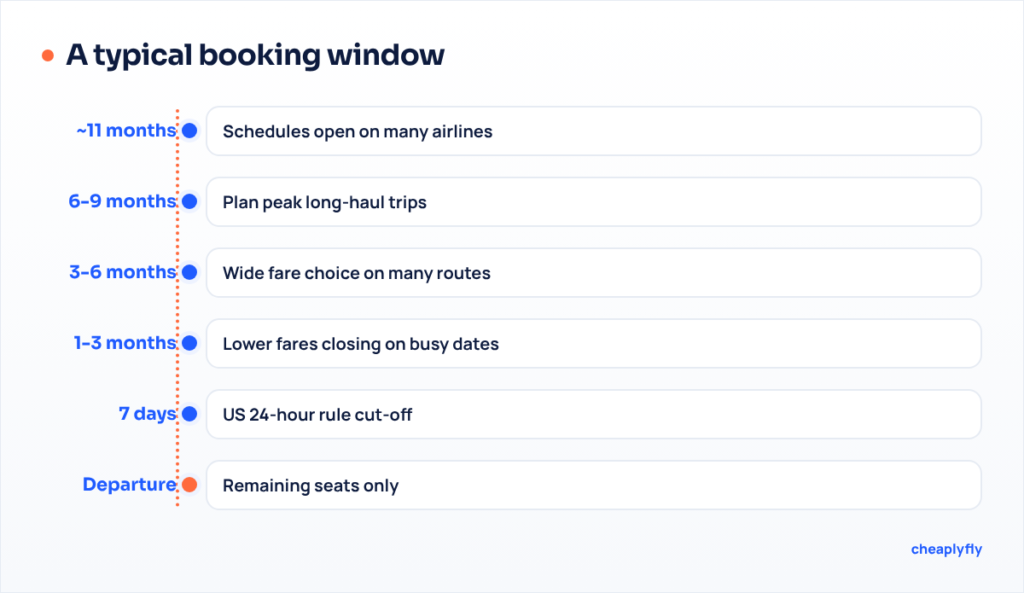
Use this timeline as a guide to what is usually happening at each stage. It describes typical behavior, not guaranteed prices, and every route is different. The best time to book flights for your trip sits somewhere on this line, and it moves earlier the busier your dates are.
- Around 11 months out
Many airlines open their schedules roughly a year ahead. British Airways sells up to 355 days ahead and Qantas up to 353 days ahead, as of Oct 2026. This is the time to lock in trips tied to fixed, high-demand dates.
- 6 to 9 months out
A good period to plan long-haul trips over peak holidays. Start watching prices and set an alert, even if you are not ready to buy.
- 3 to 6 months out
For many international trips, fare options are wide and plenty of seats remain. Compare dates on a calendar view and settle on a target price.
- 1 to 3 months out
For many shorter trips this is a comfortable buying window. On popular dates, the lowest fare levels may already be closing, so act when you see your target.
- 3 to 6 weeks out
Some advance purchase fares start to expire. If an alert has not shown a drop, waiting much longer rarely helps on busy routes.
- 7 days out
In the United States, the 24-hour hold-or-cancel rule only applies to tickets bought at least seven days before departure, so booking later removes that safety net.
- Departure week and day
Seats may still be available, but you are buying from whatever fare levels remain. Expect higher prices on busy routes and fewer choices.
How your trip type shifts the best time to book flights
The right moment depends on what kind of trip you are taking. Three common situations show how the advice changes.
Peak holiday with fixed dates
School breaks and year-end holidays fill early. Book well ahead, ideally once the schedule is open and you see a price within your budget. Waiting usually means fewer seats at the lower fare levels.
Flexible getaway in a quieter month
You have more time and more options. Use a calendar view, set an alert, and wait for a dip. Our guide to flexible dates and price calendars shows how to spot the cheaper days.
Short-notice trip
When you must travel soon, flexibility is your best lever. Check nearby airports, connecting options and different departure times, and compare the total cost including bags.
Using alerts and booking protections to time your purchase
You cannot predict the exact low point of a fare, and nobody else can either. What you can do is watch the price without effort and make a calm decision. Set an alert for your route and dates, then book when the fare reaches the price you decided on. Our guide to flight price alerts explains how to act when one fires, and you can set one up from the price alerts page.
Some airlines let you hold a fare. American Airlines offers a free hold of up to 24 hours on select flights booked at least seven days ahead, and British Airways offers a paid option to hold a fare for up to 72 hours. Conditions change, so check the airline’s current terms.
In the United States, the 24-hour reservation requirement means airlines must either hold a reservation at the quoted fare for 24 hours without payment or let you cancel within 24 hours for a full refund, for tickets bought at least seven days before departure. It applies to airlines, not to third-party agents, so check the agency’s policy if you book through one. Rules differ by region, so always read the conditions on the booking site.
The DOT also advises that after buying, it can be worth checking the fare again, because some airlines will refund the difference if the same fare drops. You have to ask, and many fares do not allow it, so read the rules of your ticket.
A simple plan for your next booking
- Decide how fixed your dates are and whether they fall in a busy period.
- Check the route on a calendar view to see the normal price range.
- Set a target price based on that range and your budget.
- Turn on an alert and check the total cost, including bags, when it fires.
- Book when the price meets your target, and do not chase small further drops.
For the full search process that sits around this timing decision, see how to find cheap flights step by step. The best time to book flights is the moment a fare you have researched meets the price you set, and the steps above help you recognize that moment.
Frequently asked questions
How far in advance should I book an international flight?
There is no single number. For peak dates, booking several months ahead protects you from the lower fare levels selling out. For quieter dates, you can often watch prices for longer. Check a calendar view and set an alert to see the normal range.
Is it cheaper to book flights on a particular day of the week?
Airlines change prices continuously, so the day you buy matters much less than the day you fly. Testing different travel dates usually saves more than waiting for a certain shopping day.
Do flight prices go down closer to departure?
Sometimes, but on busy routes they usually go up, because the cheaper fare levels sell first. Relying on a last-minute drop is a gamble.
How early can I book a flight?
Many airlines open bookings around 11 months ahead. British Airways allows up to 355 days and Qantas up to 353 days, as of Oct 2026. Check the airline’s own site for its current limit.
What happens if the price drops after I book?
It depends on your ticket and the company you booked with. Some airlines will refund the difference or give a credit if you ask, while many basic fares do not allow it. Contact the airline or travel agency you booked with.
Should I wait for a sale?
If your dates are flexible and far away, setting an alert to catch a sale is sensible. If your dates are fixed and busy, waiting for a sale risks losing the lower fares that are available today.
Sources
- US Department of Transportation: Getting the Best Airline Fares
- US Department of Transportation: Guidance on the 24-hour reservation requirement
- Delta Air Lines: Fares and discounts
- British Airways: How far in advance can I book a flight?
- Qantas: Book flights
- American Airlines: Hold your reservation
- British Airways: Hold your flight price