First-Time Flyer Guide: Everything From Booking to Landing
A start-to-finish journey map for your first flight, from booking and packing to security, boarding and arrival, plus the airport words to know.

If this is your first time flying, the hardest part is not knowing what comes next. This guide maps the whole journey step by step, from booking your ticket to walking out of the arrivals hall, and explains the airport words you will hear along the way.
Key takeaways
- Book with the exact name on your ID, and read what your fare includes before you pay.
- Check in online, save your boarding pass offline, and know your airline’s bag drop and gate closing times.
- Pack liquids, electronics and medicines in your carry-on so they are easy to take out at security.
- Follow the signs and screens: departures, security, then your gate number on the boarding pass or departure board.
- Airport and cabin staff answer first-time questions every day. Asking is always fine.
Before you book: a few decisions that make the day easier
A smooth flight starts with the booking. Enter your name exactly as it appears on the passport or ID you will travel with, because airlines and security check that the two match. A name error can be costly or slow to fix.
Read what the fare includes. Many low fares cover only a small bag that fits under the seat, with larger carry-on bags, checked bags and seat selection charged extra. Comparing the total price is part of finding a genuinely cheap flight. When you search on Cheaplyfly, you compare options and then book and pay on the airline’s or travel agency’s site, which issues your ticket.
For your first time flying, a nonstop flight at a comfortable hour removes a lot of stress. If you need a connection, choose one with a generous layover.
Documents to check before you book
- International trips: a valid passport, and any visa or travel authorization your destination requires. The US State Department’s traveler’s checklist is a useful model wherever you live.
- Domestic flights in the US: adults need an acceptable ID such as a REAL ID-compliant license or a passport. REAL ID enforcement began on 7 May 2025.
- Domestic flights elsewhere: check your airline’s ID rules, which vary by country.
Your journey map for first time flying
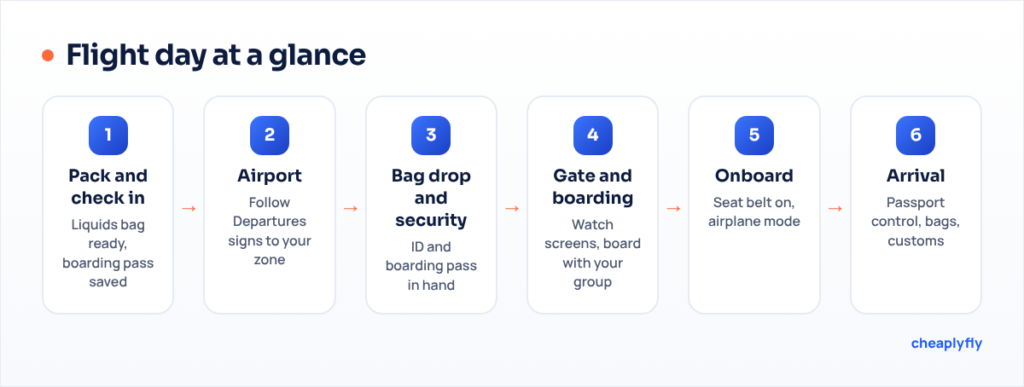
Here is the full sequence of a typical flight day, in order. Each stage tells you what happens, what you need in your hand, and the one mistake to avoid.
- Days before: book and prepare
Save your booking confirmation and booking reference (a six-character code). Add the airline’s app if it has one. Check the baggage allowance printed on your booking.
- 1 to 3 days before: pack
Put liquids, gels and creams in small containers in one clear bag; in the US, the TSA’s 3-1-1 rule allows containers of 3.4 ounces (100 milliliters) or less in one quart-sized bag per passenger. Many airports worldwide use a similar 100 mL limit, but check your departure airport. Keep medicines, chargers, keys and valuables in your carry-on. Our guide to carry-on rules covers sizes and what is allowed.
- 24 to 48 hours before: check in online
Most airlines open online check-in a day or two before departure. Confirm your details, choose a seat if needed, and download the boarding pass to your phone or print it. See online check-in and boarding passes for how it works.
- Leaving home
Work backward from your airline’s gate closing time. For example, easyJet closes its gates 30 minutes before departure, and bag drop earlier. Allow time to get to the airport, drop bags, go through security and walk to the gate.
- At the airport: find your terminal and desk
Follow signs for Departures. Screens list each flight with a check-in or bag drop zone. If you are only carrying hand luggage and checked in online, you can usually go straight to security.
- Bag drop
Show your ID and boarding pass, put your bag on the scale, and keep the baggage tag receipt the agent gives you. It is your proof if the bag goes missing.
- Security
Have your boarding pass and ID ready. Place your bag, coat and often your liquids bag and larger electronics in the trays as instructed, then walk through the scanner when called. Our airport security tips explain how to get through faster.
- Passport control (international flights)
Some countries check passports on departure as well as arrival. Have your passport open at the photo page.
- Airside: find your gate
Look up your flight on a departure board. The gate number may appear only an hour or so before departure, so check the screens and your airline app rather than waiting at a random spot.
- Boarding
Boarding usually happens in groups or zones printed on your pass. When your group is called, show your boarding pass and sometimes your ID, then walk to the aircraft.
- On board
Find your seat using the row number and letter. Put larger bags in the overhead bin and small items under the seat in front. Fasten your seat belt, set your phone to airplane mode and listen to the safety briefing.
- Landing and arrival
Stay seated until the seat belt sign turns off. Follow signs for Arrivals or Baggage Claim, go through passport control and customs if your trip is international, then collect your checked bag from the carousel shown on the screens.
On board: what to expect in the air
The cabin crew are there for your safety first and service second. Follow their instructions, especially the seat belt sign. The US Federal Aviation Administration says phones and other devices must be used in airplane mode or with cellular data disabled, and that you should follow crew instructions at all times; airlines elsewhere apply similar rules.
Your ears may feel blocked as the plane climbs or descends. Swallowing, yawning or chewing usually helps. Some bumps are normal; turbulence is why crews ask you to keep your seat belt fastened while seated.
Seat choice affects comfort more than most first-timers expect. A window gives a view and something to lean on; an aisle makes it easy to get up. Our guide on choosing the best airplane seat covers the trade-offs.
Bring a refillable water bottle (empty through security), a light layer, and a snack. Cabins can feel cool and dry, and food is not always included.
Common first-time worries, answered
Myth: You need to arrive at the airport many hours early.
Fact: You need enough time for your airline’s deadlines, security and the walk to the gate, plus a buffer. In the US, TSA has advised about two hours for domestic and three for international flights; elsewhere, check your airport’s advice.
Myth: If the gate changes, someone will come and find you.
Fact: Gate changes are shown on the screens, announced, and often pushed to the airline app. It is your job to keep an eye on them.
Myth: You must print your boarding pass.
Fact: Most airlines accept a mobile boarding pass. Some airports and routes still require paper, so check your airline’s instructions.
Airport words you will hear
Airports have their own vocabulary. These are the terms that come up most often on a first trip.
- Airside / landside
- Landside is the public area before security. Airside is everything after security, including the gates and shops.
- Booking reference
- A short code, often six characters, that identifies your booking with the airline. Also called a PNR or record locator.
- Boarding pass
- The document, paper or mobile, that shows your flight, seat, gate and boarding group. You need it at security and the gate.
- Bag drop
- The desk where passengers who have checked in online leave their checked bags.
- Carry-on
- A bag you take into the cabin. Also called hand luggage or cabin bag.
- Checked bag
- A bag that travels in the aircraft hold and is collected at baggage claim.
- Connection / layover
- A stop between two flights on the same journey, where you change aircraft.
- Gate closing time
- The last moment you can board. After it, the airline may give your seat away.
- Carousel
- The moving belt in baggage claim where checked bags arrive.
- Customs
- The check on arrival in a new country for goods you bring with you, often with “nothing to declare” and “goods to declare” channels.
- Operated by
- Shows which airline actually flies the plane when it differs from the one that sold the ticket (a code-share).
A day-before checklist
The night before your flight
- Passport or ID packed in an easy-to-reach pocket.
- Boarding pass downloaded, plus a screenshot as backup.
- Liquids in one clear bag, near the top of your carry-on.
- Phone charged, charger and power bank packed in your carry-on, not your checked bag.
- Route to the airport planned, with your leave time worked out.
- Flight status checked in the airline app or website.
- Address of your first night’s stay saved offline.
Ready to plan your first trip? Use the flight search to compare dates and routes, then book with the airline or agency that suits you.
Frequently asked questions
What do I need to bring for my first time flying?
Valid ID or a passport, your boarding pass, and any documents your destination requires. Keep them together and easy to reach for security, boarding and arrival.
Can I bring food on a plane?
Solid snacks are generally fine in your carry-on. Spreadable or liquid foods count as liquids at security. Some countries restrict bringing fresh food in on arrival, so finish or declare it.
What happens if I miss my flight?
Contact the airline or the agency you booked with straight away. Options depend on your fare rules; some airlines offer a later flight for a fee, while others treat you as a no-show.
Do I need to take my laptop out at security?
It depends on the airport and its scanners. Follow the signs and staff instructions at the checkpoint, which tell you what to place in the trays.
Is it normal to feel nervous about flying?
Yes, many people do. Knowing each step in advance helps, and you can tell the cabin crew when you board; they are used to helping nervous flyers.
Who do I contact if my flight changes?
The airline or travel agency you paid, since it issued your ticket. Cheaplyfly helps you compare flights but does not manage bookings.