Lost or Delayed Baggage: Claims, Deadlines and Compensation
Bag missing or damaged? Learn the written deadlines, current liability limits, the documents airlines want and how to structure your claim.

Standing at an empty carousel is stressful, but a lost luggage claim is mostly a matter of paperwork and dates. Report the problem before you leave the airport, put it in writing within the treaty deadlines, and keep every receipt. This guide sets out those deadlines, the documents airlines ask for, the current compensation limits and a claim letter outline you can adapt.
Key takeaways
- Report a missing or damaged bag at the airport before leaving the baggage hall and get a written reference.
- On international trips under the Montreal Convention, written complaints are due within 7 days for damage and 21 days for delay; a bag still missing 21 days after it should have arrived can be treated as lost.
- The Montreal Convention limit for baggage rose to 1,519 Special Drawing Rights (SDR) per passenger on 28 Dec 2024; US domestic flights have their own limit of USD 4,700 as of Oct 2026.
- Keep receipts for essentials you buy while your bag is delayed, and claim with the airline in writing.
- This is general information as of Oct 2026, not legal advice.
Which rules cover your bag
For most international flights, baggage claims fall under the Montreal Convention 1999, a treaty with about 140 parties, according to ICAO, that sets the airline’s liability and the deadlines for complaints. EU law applies the Montreal rules to EU airlines on all their flights, including domestic ones, and the EU’s Your Europe guide summarizes the deadlines. Trips involving a country that has not joined the Montreal Convention may instead fall under the older Warsaw system, which has lower limits.
Domestic flights follow national rules. In the US, the Department of Transportation (DOT) sets a separate domestic limit and requires refunds of bag fees in some cases. Canada’s Air Passenger Protection Regulations apply Montreal-level limits to domestic flights too. Whichever rule applies, the airline’s own conditions of carriage add the practical details, such as where to send a claim.
| Trip type | Main rule | Maximum liability (as of Oct 2026) |
|---|---|---|
| International, both countries in the Montreal Convention | Montreal Convention, Articles 17, 19, 22, 31 | 1,519 SDR per passenger, unless you declared a higher value and paid any supplement at check-in |
| EU airline, any route | Montreal Convention as applied by EU law | Same as above |
| US domestic | 14 CFR Part 254 and DOT rules | USD 4,700 per passenger (since 22 Jan 2025; reviewed every two years) |
| Canada domestic | Air Passenger Protection Regulations | Aligned with the Montreal Convention limit |
The SDR is a basket currency defined by the International Monetary Fund; its value moves daily. When ICAO announced the new limits in Oct 2024, 1,519 SDR was worth roughly USD 2,000. Check today’s rate on the IMF SDR valuation page. These are maximums, not fixed payouts: you are reimbursed for proven loss up to the limit.
Lost luggage claim deadlines, step by step
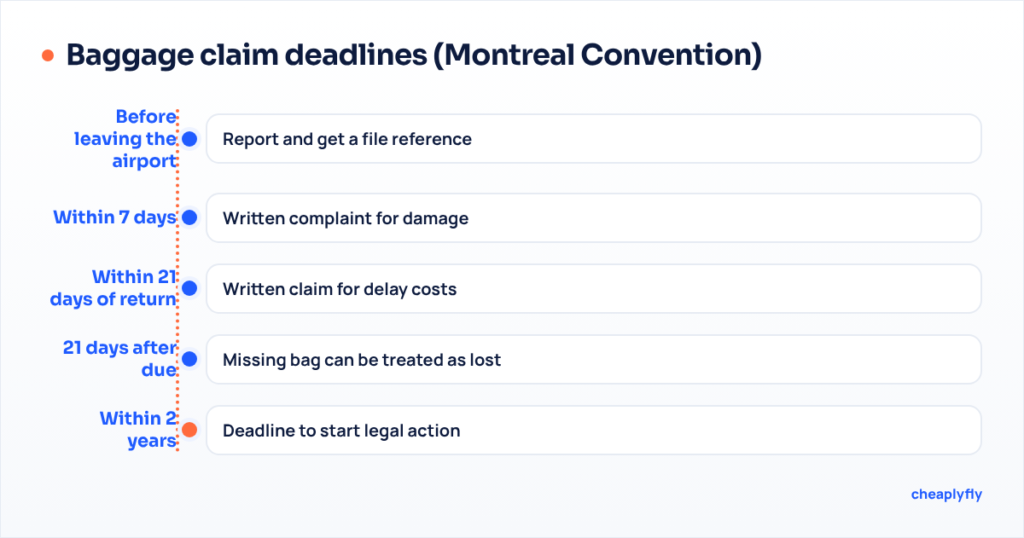
The Montreal Convention is strict about time. Under Article 31, a complaint must be in writing and sent within the deadline, or the right to claim is lost except in case of fraud by the airline. The timeline below shows when each step falls due.
- At the airport, before you leave
Report the missing or damaged bag at the airline’s or handling agent’s baggage desk. You will get a file reference, often called a Property Irregularity Report (PIR). Photograph the report and any damage.
- Within 7 days of receiving a damaged bag
Send a written complaint describing the damage. Many airlines apply the same 7-day deadline to items missing from a bag that did arrive, so treat it as the safe limit.
- Within 21 days of a delayed bag being returned to you
Send a written claim for costs caused by the delay, such as toiletries and clothes, with receipts. The 21 days run from the day the bag is placed at your disposal.
- 21 days after the bag should have arrived
If it is still missing, Article 17 lets you treat it as lost and claim for its contents. Some airlines declare a bag lost earlier. Send a written lost luggage claim promptly once that happens.
- Within 2 years of arrival
Under Article 35, legal action must be started within two years from the date of arrival, or the date the aircraft should have arrived. After that, the right to damages ends.
Do not rely on a phone call or an online chat as your formal complaint. Send it in writing, using the airline’s claim form or email address, and keep proof of the date you sent it.
The documents airlines ask for
Airlines assess claims on evidence. The more of this you can supply, the less back-and-forth you will face.
Documents checklist
- Your booking confirmation or e-ticket and boarding passes.
- The baggage claim tag receipt, usually stuck to your boarding pass or ticket jacket.
- The airport report reference (PIR) and a copy of the report.
- Photos of the bag and any damage, taken before you unpack.
- A list of contents with approximate age and value, and receipts where you have them.
- Receipts for essentials bought while the bag was delayed.
- Bank details and the payment method you prefer.
Buy only what you genuinely need while waiting, at a reasonable price. Airlines usually pay for essentials, not for a full new wardrobe, and they deduct for the age of lost items when valuing them.
Before your next trip, photograph the inside of your packed bag and keep valuables, medicines, documents and electronics in your carry-on. Most airlines limit or exclude liability for those items in checked baggage. Our guide to carry-on rules covers what you can bring in the cabin.
Sample claim letter outline
A clear, structured letter speeds up handling. Adapt this outline to your situation and send it through the airline’s claim channel.
Claim letter outline
Subject line: Baggage claim, file reference [PIR number], flight [number] on [date, e.g. 8 Oct 2026].
Opening: Your full name, booking reference, flights and the bag tag number. State whether the bag was delayed, damaged or lost.
Facts: When you reported it at the airport, when (or whether) the bag was returned, and what was damaged or missing.
Legal basis: For international trips, cite the Montreal Convention (Article 17 for loss or damage, Article 19 for delay) and note that you are writing within the Article 31 deadline. For US domestic trips, refer to the DOT baggage rules.
Amount claimed: An itemized table with each item or expense, its cost and the receipt reference, and a total.
Request: Payment by bank transfer or to the original card, a refund of any bag fee paid, and a reply within a reasonable time, such as 30 days.
Attachments: List every document from the checklist above.
Keep the tone factual. If the airline offers a voucher, you can accept or decline it; ask for money if you prefer.
Extra protections on US flights
US rules add two practical benefits. First, under the DOT refund rule, an airline must refund the checked bag fee if you filed a mishandled baggage report and the bag was significantly delayed: more than 12 hours after a domestic flight arrives, 15 hours for international flights of 12 hours or less, and 30 hours for longer international flights. Second, bag fees must be refunded if the bag is lost. The DOT baggage page also notes that airlines should cover reasonable expenses while a bag is delayed.
The US domestic limit is set in 14 CFR Part 254 and adjusted every two years, so check the current figure before you claim a large amount.
When your bag goes missing on a connection or with a low-cost airline
Bags are most often mishandled on tight connections or after a rebooking. On a single ticket you can claim with the first or last airline on the journey, or with the one that operated the flight where the problem occurred. If you were rebooked after a missed connection, report at your final destination and mention both flights.
Low-cost airlines follow the same Montreal Convention limits and deadlines, but their claim channels can be online only and their terms may be stricter about what counts as fragile or valuable. Our guide on what low-cost airlines include explains checked bag allowances and fees.
Delayed bags often come with a delayed or canceled flight. Compensation for the flight itself is a separate claim; see your rights when a flight is delayed or canceled.
When you book a trip found on Cheaplyfly, the airline or travel agency you book with handles the contract. For bag problems, contact the airline that carried you; it holds the baggage records. Our help center explains how the booking process works.
Frequently asked questions
How long does an airline have to find my bag?
Under the Montreal Convention you can treat a checked bag as lost if it has not arrived 21 days after it should have. Many bags are traced well before that.
What is the deadline for a lost luggage claim?
Once the bag is declared lost or the 21 days pass, submit the claim in writing as soon as possible. Legal action must start within two years of arrival.
Will I get the full value of my lost items?
Usually not the replacement price. Airlines reimburse proven loss, often reduced for the age of items, and only up to the applicable limit.
I left the airport without reporting the delay. Can I still claim?
Yes, contact the airline right away and file a report online or by phone, then follow up in writing within the deadlines. Reporting at the airport simply makes it easier.
Can I declare a higher value for my bag?
Some airlines accept a special declaration of value at check-in for a fee, which raises their liability. Ask at check-in; not every airline offers it.
Does travel insurance replace an airline claim?
No, it usually complements it. Insurers often ask for the airline’s report and its response, so claim with the airline first.
Sources
- EUR-Lex: Convention for the Unification of Certain Rules for International Carriage by Air (Montreal, 1999)
- ICAO: International air travel liability limits set to increase
- IMF: SDR valuation
- Your Europe: Air passenger rights
- US Department of Transportation: Lost, delayed or damaged baggage
- eCFR: 14 CFR Part 254, Domestic baggage liability