Missed Your Connecting Flight? What to Do Next
Missed your connection? Here is what to do minute by minute, why one ticket or two changes everything, and what you can claim afterward.
A missed connecting flight feels like a crisis while you sprint through a terminal, but the outcome is mostly decided before you land: by whether both flights are on one ticket. This guide gives you a minute-by-minute plan from the moment you realize you will be late, explains what changes when you hold separate tickets, and shows what you can claim afterward.
Key takeaways
- On a single ticket, the airline that sold the itinerary must get you to your destination, usually at no extra cost, if its delay caused the miss.
- On separate tickets, the second airline normally treats you as a no-show. You may need to buy a new ticket and protect the rest of your booking.
- Start rebooking before you get off the plane: check the airline app, then go to the transfer desk and phone the airline at the same time.
- In the EU and UK, a missed connection on one booking can lead to compensation if you reach your final destination 3 hours or more late and the cause was in the airline’s control.
- Rules are summarized as of Oct 2026 and are general information, not legal advice.
Why one ticket or two changes everything
Airlines and travel agencies sell connections in two ways. A single ticket (one booking reference covering every flight) is a promise to carry you from origin to destination. A separate-ticket or self-transfer trip is two or more independent contracts that you joined together yourself, or that an agency joined for you.
You can usually tell which you have from the confirmation email: one booking reference and one e-ticket number for the whole trip means a single ticket. Two references, two check-ins, or the words “self-transfer” or “virtual interlining” mean separate tickets.
| Question | Single ticket | Separate tickets |
|---|---|---|
| Who rebooks you? | The airline or agency that issued the ticket | Nobody automatically; you deal with the second airline yourself |
| Extra cost? | Usually none when the first flight’s delay caused the miss | Often a new fare, unless the seller offers its own transfer guarantee |
| Checked bags | Normally tagged through to your destination | You collect and re-check them, which takes extra time |
| Meals and hotel | Owed under some regional rules and airline policies | Rarely owed for the onward flight you missed |
| Compensation (EU/UK) | Based on arrival delay at the final destination | Each flight judged on its own; the missed onward flight is generally not covered |
If you often book separate tickets to save money, our guide to self-transfer flight risks explains how to protect yourself before you buy.
Minute-by-minute plan for a missed connecting flight
Times below are a guide, not a stopwatch. The point is to work in parallel: while one channel is busy, another may already have a seat for you.
- Before landing (when you realize you will be late)
Tell the cabin crew you have a tight connection; on a single ticket they may know whether the next flight will wait or whether you have been rebooked. Use onboard Wi-Fi, if available, to open the airline app and look at your trip. Note your onward flight number and the alternatives on the departures list.
- Doors open (minute 0)
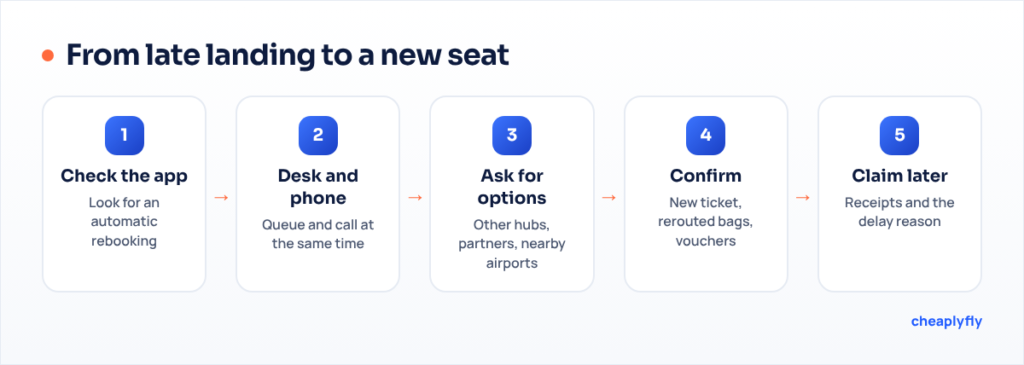
Check the app and your email for an automatic rebooking. Airlines often rebook passengers on a single ticket before they reach the gate. If a new boarding pass is already there, head straight to the new gate.
- Minutes 1 to 10
If you are on a single ticket, follow signs for transfers or connections, not baggage claim, and find the airline’s transfer desk. Join the queue and call the airline’s support line at the same time. If you hold separate tickets, go to the check-in or ticket desk of the second airline instead.
- Minutes 10 to 30
Ask for specific options rather than “the next flight.” Suggest routes through another hub, partner airlines, or a nearby arrival airport. Ask whether a later flight today is better than a guaranteed seat tomorrow.
- Minutes 30 to 60
Before leaving the desk, confirm three things: a new boarding pass or ticket number, that your checked bags are rerouted, and any meal vouchers. Ask for the reason for the original delay in writing; you will need it for a claim.
- If you are stuck overnight
Ask whether a hotel and transport are provided. If you must book your own, keep it reasonable and keep every receipt. Check the entry requirements of the connecting country before leaving the airport.
- Within days of getting home
Collect boarding passes, receipts and the delay reason, and submit any compensation or expense claim to the operating airline.
If you hold separate tickets
On separate tickets, the onward airline has no duty to wait for you or rebook you for free. It sees a passenger who did not turn up. Work through these points in order.
- If the seller offered a transfer guarantee
Then contact that company first, before buying anything. Follow its process exactly; guarantees often require you to report the missed flight within a set time.
- If you can still make the onward flight late in check-in
Then go straight to that airline’s desk and ask. Some airlines will help for a fee or move you to a later flight under their own fare rules.
- If the onward flight has left
Then ask the second airline what a change costs on your existing ticket before buying a new one. A change fee plus fare difference can be cheaper than a fresh one-way fare.
- If your onward ticket includes a return
Then tell the airline you still intend to fly the return. Many airlines cancel the remaining flights on a ticket once one flight is missed without notice.
Separate tickets can still give you rights on each flight individually. If your first flight was delayed 3 hours or more at its own arrival, EU or UK rules may cover that flight. But the cost of the missed onward ticket is generally yours to bear unless a guarantee or travel insurance covers it.
What you can claim after a missed connection
Your rights follow the same regional rule books that apply to any delay. Our guide on delay and cancellation rights by region has the full table; here is how each applies to connections.
EU and UK
Under Regulation (EC) No 261/2004 and the UK’s retained version, a single booking is judged by the arrival time at your final destination. If you get there 3 hours or more late because of a missed connection, and the cause was within the airline’s control, fixed compensation can apply. The UK Civil Aviation Authority states that late arrival at the connection point itself does not count, only the final destination. See the CAA guidance on delays and the EU’s Your Europe page.
United States
There is no federal compensation for delays. The airline’s customer service plan sets what it offers for rebooking, meals and hotels. If a long delay turns into a significant change and you choose not to travel, the US DOT refund rules can entitle you to a refund to your original payment method.
Canada
Canada’s Air Passenger Protection Regulations cover connecting flights. Compensation is measured by how late you reach your final destination and depends on the airline’s size and whether the disruption was within its control, as the Canadian Transportation Agency explains.
Worked example (illustrative)
A traveler books one ticket from Lisbon to Toronto via Frankfurt. A technical fault delays the first flight by 90 minutes, and they miss the connection. The airline rebooks them on the next day’s flight, provides a hotel and meals, and they arrive in Toronto 22 hours late. Because the trip departed from the EU on a single booking, the delay was in the airline’s control, and the flight is over 3,500 km, EU261 compensation at the top distance band can apply. Had the same traveler booked the two flights separately, the second airline would have treated them as a no-show and the new Frankfurt to Toronto fare would have been their own cost.
Your checked bags when you miss a connection
On a single ticket, bags are usually tagged to your final destination and rerouted with you, but they do not always make the same new flight. Ask the desk to confirm the bag is on your new routing and photograph your bag tag receipt. If it does not appear at the carousel, report it before you leave the baggage hall; our guide to lost or delayed baggage covers the forms and deadlines.
On separate tickets, you must collect your bags, possibly clear immigration and customs, and check in again. That can mean needing a visa or travel authorization for a country you only meant to pass through. When entering the US, travelers on international itineraries generally collect and re-check bags at the first US airport even on a single ticket, so allow time for it.
How to avoid the next one
Most missed connections come from tight schedules, separate tickets and busy hubs. A little planning when you search makes them much less likely.
Before you book a connection
- Prefer one ticket for connections, especially on long-haul trips.
- Choose a layover longer than the airport’s minimum when you must change terminals, clear immigration or collect bags. Our guide on how long a layover should be walks through the factors.
- Avoid the last connection of the day, which leaves no same-day backup.
- Save the airline’s app, phone number and your booking reference before you travel.
- Keep essentials and a change of clothes in your carry-on.
When you compare options on Cheaplyfly, look at the layover length and whether the route is one ticket before choosing the cheapest result. You then book directly with the airline or agency, which is the company that handles any rebooking. You can start a new comparison on the flight search page.
Frequently asked questions
Will the airline rebook me for free after a missed connecting flight?
On a single ticket, usually yes, when the airline’s own delay caused the miss. On separate tickets, generally no, unless the seller offered a transfer guarantee.
What if I missed the connection because I was slow, not because of a delay?
If the inbound flight was on time and you simply did not make it, the airline is not obliged to rebook you for free. Go to the desk anyway; many airlines will help, sometimes for a fee.
Do I get compensation for a missed connection in the US?
There is no federal compensation rule for delays. Check the airline’s customer service plan for meals, hotels and rebooking, and the DOT refund rules if you choose not to travel.
Can I go to a different airport to catch a new flight?
Ask first. If you change airports without agreement, the airline may treat it as a no-show. Some regional rules require airlines to cover transfers when they reroute you to a nearby airport.
Should I book my own replacement flight?
On a single ticket, only as a last resort and after asking the airline in writing. Otherwise you may not be reimbursed and the rest of your ticket may be canceled.
Does travel insurance help?
Some policies cover missed connections and extra costs, especially on separate tickets. Read the wording before you travel, as conditions vary widely.