Self-Transfer Flights: How They Save Money and What Can Go Wrong
Separate tickets can unlock cheaper routes, but the connection becomes your responsibility. Here is how to judge the risk and protect the trip.
Self transfer flights join two or more separate tickets into one journey, and they can unlock routes and prices that no single airline sells. The catch is simple: when the tickets are separate, so is the responsibility. This guide shows where the savings come from, ranks itineraries from lowest to highest risk, and gives you a practical plan to protect the trip.
Key takeaways
- A self-transfer means each ticket is its own contract. If the first flight is late, the second airline usually has no duty to rebook you.
- Risk climbs with every extra step at the connection: checked bags, an immigration desk, a terminal change or a different airport.
- Airline minimum connection times only apply to connections on one ticket. On separate tickets, you set the buffer, and it should be far longer.
- Check transit visa rules before booking. Collecting bags often means formally entering the country you are passing through.
- Book the cheaper self-transfer only when the saving still makes sense after you price in a flexible second ticket, insurance or an overnight stop.
What self transfer flights are and why they can be cheaper
On a normal connecting itinerary, one booking covers every leg. The airlines involved agree the connection works, your bags are tagged to the final destination, and if the first leg is late, the carrier on that ticket rebooks you. A self-transfer removes that safety net. You buy the legs separately, possibly from different airlines that have no agreement with each other, and you make the connection yourself.
The price gap usually comes from combining carriers that never sell together. A low-cost airline into a hub, plus a long-haul flight from that hub on another airline, can undercut every single-ticket option on the same day. Search tools that combine separate tickets are doing exactly this, and our guide to how flight search engines work explains how those virtual combinations are built and labeled.
Building the trip by hand works the same way. Flying from a secondary airport to a big hub, then onward, pairs naturally with the ideas in nearby airports and alternative routes.
What changes when the tickets are separate
Three protections usually disappear together. First, a missed connection is your problem, so the second airline may treat you as a no-show. Second, your bags normally stop at the connecting airport, so you collect them and check in again. Third, passenger rights that look at the whole journey may only look at each flight on its own.
The European Union is a clear example. The European Commission’s interpretative guidelines on Regulation 261/2004 (published 25 Sep 2024) say a journey of several flights is considered as a whole when the flights were booked as a single unit. Separately booked legs do not get that treatment, so a delay on leg one does not create a claim for the onward flight you missed.
A self-transfer itinerary sold as one purchase can still be two or more separate airline tickets. Read the booking confirmation: if you receive more than one airline booking reference and the terms mention “self-transfer” or “separate tickets”, treat the connection as unprotected unless the seller explicitly offers its own guarantee, and read what that guarantee covers.
The self-transfer risk ladder
Not every self-transfer carries the same risk. The ladder below ranks common setups from safest to riskiest. Each rung adds one more thing that can go wrong between landing and boarding. Use it to decide which itineraries are worth the saving and which are not.
| Rung | Itinerary type | What you must do at the connection | Main failure point |
|---|---|---|---|
| 1 (lowest) | Overnight stop between two separate tickets | Collect bags, stay the night, check in fresh the next day | Hotel cost and a lost day, but the connection itself is very hard to miss |
| 2 | Same airport, carry-on only, no border to cross | Walk to the departure gate or through a transfer security point | A long first-leg delay |
| 3 | Same airport, checked bags, no border to cross | Wait at baggage reclaim, return to check-in, clear security again | Slow baggage delivery and bag-drop deadlines |
| 4 | Same airport, international arrival with immigration | Clear passport control (and often customs), recheck bags, clear security | Immigration queues plus visa or entry eligibility |
| 5 | Terminal change at a large hub | All of the above, plus an inter-terminal train, bus or walk | Transfer time and different check-in rules per terminal |
| 6 (highest) | Change of airport in the same city | Enter the country, travel across the city, check in at another airport | Ground traffic, rail disruption and every risk above combined |
Two factors push any rung higher: a long-haul first leg, which has more ways to run late, and a second flight that is the last of the day, which leaves no same-day fallback.
Buffer time: why airline minimums do not apply to you
Airlines and reservation systems use a minimum connecting time, or MCT, for each airport. The IATA Minimum Connecting Time user guide describes it as the shortest time needed to move a passenger and their bags from one flight to the next at a given location. A connection sold on one ticket must respect that minimum, and the airline carries the risk if it fails.
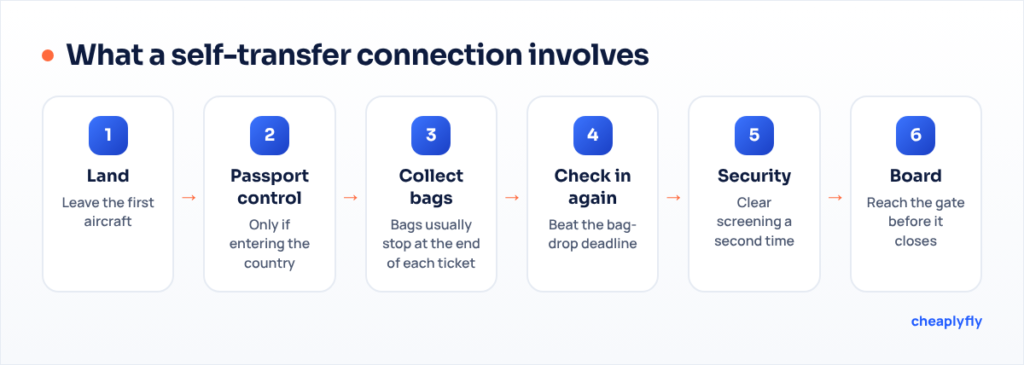
On separate tickets, none of that applies. The MCT assumes your bags move automatically and that you stay airside. A self-transfer often means waiting for luggage, queuing at check-in again and clearing security a second time. Most airlines also close check-in and bag drop well before departure, and that deadline, not the departure time, is the real end of your connection window.
For the general principles of picking connection times on a single ticket, see how long a layover should be. The guidance below is deliberately more cautious, because on separate tickets a missed flight usually means buying a new one.
A protect-yourself plan for self transfer flights
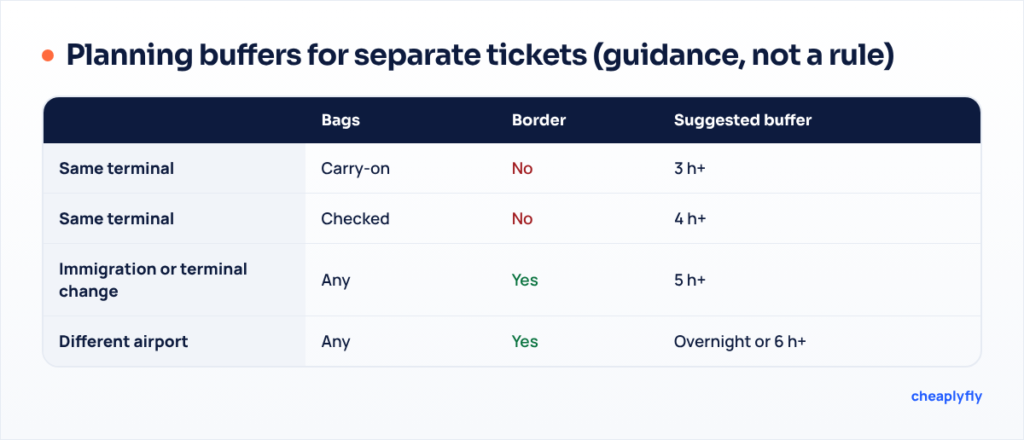
The plan has two parts: a buffer that matches the airport situation, and a short list of actions before and during travel. The buffer guidance is Cheaplyfly’s planning advice, not an airline or legal rule. Measure it from scheduled arrival to scheduled departure, then add more for long-haul inbound flights, winter weather or very busy hubs.
- If you stay in one terminal with carry-on only and no border
Then plan at least 3 hours. That covers a moderate first-leg delay and a second security check if the airport requires one.
- If you have checked bags but no immigration
Then plan at least 4 hours. Baggage reclaim can be slow, and you must reach bag drop before it closes, which is often an hour or more before departure.
- If you must clear immigration or change terminals
Then plan at least 5 hours, and more at hubs known for long passport-control queues at peak times.
- If you change airports in the same city
Then plan an overnight stop or at least 6 hours, and check the ground-transport timetable for the exact day and time you will travel.
- If the second flight is the last of the day or the first leg is long-haul
Then seriously consider an overnight stop. A hotel night can be cheaper than a new same-day ticket bought at the airport.
Before you book
-
Check entry and transit rules for the connecting country
If you must collect bags or change airports, you are formally entering that country. The UK government’s guidance on transit visas, for example, separates airside transit from going through border control, and some travelers need a different visa for each. Our travel documents checklist covers passports, visas and electronic travel authorizations.
-
Know whether you can stay airside
Some countries require every international arrival to clear entry at the first airport, even when connecting. The Port of Seattle, for example, explains in its international arrivals guidance that arriving passengers clear passport control at their first US point of entry and claim checked bags first, even when connecting.
-
Price the second ticket’s flexibility
Compare the cheapest fare on the onward leg with a version that allows changes. If the flexible version costs only a little more, it can turn a missed connection from a total loss into a change fee.
-
Read any insurance or guarantee wording
Some travel insurance policies cover missed connections on separate tickets; many do not. If the seller offers a connection guarantee, check whether it pays for a new flight, rebooks you, or only gives a partial refund.
On the day of travel
- Check in online for both flights where the airlines allow it, and save both boarding passes offline.
- Travel with carry-on only if you can; it removes the slowest step of the connection.
- Know the bag-drop closing time for the second flight, not just the departure time.
- If the first leg is clearly going to be very late, contact the second airline before departure rather than after.
What happens if you miss the onward flight
If the first airline delays or cancels your flight, it owes you whatever its own ticket and local rules provide: rebooking, a refund, care or compensation for that leg. It generally owes you nothing for the separate onward ticket. The second airline will usually treat you as a no-show, and many airlines then cancel any later flights on that same ticket, including the return.
That is why you should act quickly. Call or message the second airline as soon as you know you will miss the flight. Some carriers will move you to a later flight for a fee if you contact them before departure, while a no-show may lose the whole fare. Our step-by-step guide on what to do after a missed connection walks through the conversations to have and the receipts to keep.
Worked example (illustrative)
A traveler finds a self-transfer route for USD 420 against USD 560 on a single ticket, a USD 140 saving. The second leg is a basic fare with no changes allowed. Upgrading the second leg to a changeable fare for USD 45 and adding a 5-hour buffer keeps most of the saving while capping the downside. These numbers are invented to show the reasoning, not real prices.
When a self-transfer is worth it, and when it is not
Good fit
- Flexible travelers with no fixed arrival commitment
- Carry-on-only trips with a long buffer or an overnight stop
- Routes where the saving is large compared with the cost of a replacement ticket
- Connections in a country you can already enter without a visa
Poor fit
- Trips tied to a wedding, cruise departure, event or business meeting
- Travelers with children, mobility needs or lots of luggage
- Tight connections, airport changes or a last flight of the day
- Any itinerary where you are unsure about transit or entry rules
When you compare options on Cheaplyfly, look at the total cost of the protected version and the self-transfer version side by side. You can run a search with your dates and see whether the cheaper option is worth the extra planning. If the saving is small, the single ticket usually wins.
Frequently asked questions
Are self transfer flights legal?
Yes. Buying separate tickets and connecting yourself is a normal, legal way to travel. The risk is commercial, not legal: if you miss a flight on a separate ticket, the airline is usually not obliged to help.
Will my bags be transferred automatically?
Usually not. On separate tickets, bags are normally checked only to the end of each ticket, so you collect them and check in again. A few airlines and airports offer transfer services between partners, but confirm it in writing before relying on it.
Do I need a visa for a self-transfer?
You might. If you must leave the airside area to collect bags, change terminals through a public area or change airports, you are entering the country and need to meet its entry rules. Check the official government page for the connecting country.
What is a safe layover on separate tickets?
There is no official number. As planning guidance, allow at least 3 hours for a carry-on connection with no border, 4 hours with checked bags, 5 hours with immigration or a terminal change, and an overnight stop or 6 hours or more when changing airports.
Can I claim compensation if a delay makes me miss my second flight?
You may be able to claim for the delayed flight itself under its own rules, but generally not for the separate onward ticket you lost. Under EU rules, for example, connections are treated as one journey only when booked as a single unit.
Does Cheaplyfly sell or protect self-transfer tickets?
No. Cheaplyfly helps you search and compare options. You book and pay with the airline or travel agency, and their terms decide what is protected.