Carry-On Rules Explained: Sizes, Liquids and What to Pack
Airlines set the bag size; security sets the liquids rule. Here is how both work as of Oct 2026, plus a simple packing grid for any trip length.
Carry on rules have two layers: what the airline lets you bring into the cabin, and what airport security lets through the checkpoint. Get both right and you skip bag fees, keep your valuables close and avoid giving up a favorite face cream at the scanner.
Key takeaways
- Bag size, weight and the number of pieces are set by each airline and fare, so check the fare you are actually buying.
- The 100 ml (3.4 oz) liquids limit still applies at most airports worldwide as of Oct 2026.
- Some airports with new CT scanners allow larger containers, but the rule is set airport by airport, so the strictest airport on your route decides what you pack.
- Spare lithium batteries and power banks belong in the cabin, not in checked bags.
- Packing to trip length, not to bag size, is the easiest way to travel with one small bag.
Two sets of carry on rules: airline and security
The airline decides the size, weight and number of bags you can take on board. Those limits vary between airlines and often between fares on the same flight. A basic or light fare may include only a small personal item that fits under the seat, while a standard fare adds a larger bag for the overhead bin.
Security authorities decide what can pass through the checkpoint: liquids, sharp objects, tools and dangerous goods. These rules come from national regulators such as the TSA in the United States, the Department for Transport in the UK and the European Commission for EU airports. They apply whichever airline you fly.
Because the two layers are separate, a bag can be the right size and still be stopped at security, or pass security and then be too big at the gate. Checking both before you pack is what keeps the trip smooth.
Bag size, weight and the personal item
There is no single global cabin bag size. Each airline publishes its own maximum dimensions and, in some cases, a weight limit. Low-cost carriers tend to be the strictest, and many charge for a full-size cabin bag. Our guide to what low-cost airlines include in the fare explains how those bundles usually work.
Where to find the real limit
Look at the baggage section of the airline’s website and the fare details for your booking, not a general chart. The limit shown during booking for your specific fare is what the gate staff will apply. When you compare options on Cheaplyfly, open the fare details for each flight and check what cabin bag is included before you choose the cheapest result.
Why the cheapest fare can cost more
A bag fee added at the airport is often higher than the same bag bought during booking. If you know you need a full-size cabin bag, compare the total price, not the headline fare. Our breakdown of the true cost of a cheap fare shows how bags, seats and extras change the final number.
Measure your bag with wheels, handles and outside pockets included, and weigh it after packing. Soft bags that squeeze into a sizer at the gate are more forgiving than rigid cases.
The liquids rule: 100 ml and where it is changing
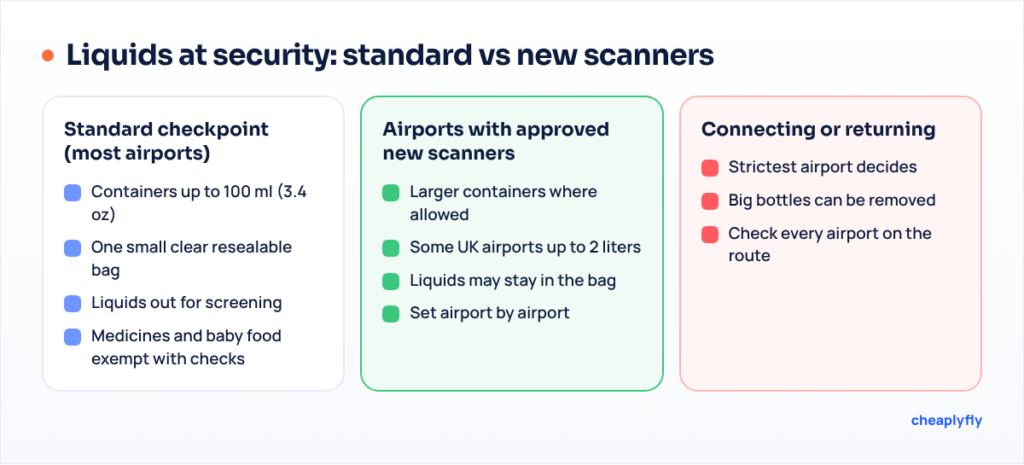
For years the standard rule has been the same almost everywhere: liquids, aerosols, gels, creams and pastes in containers of up to 100 ml each, all packed in one small transparent resealable bag. In the United States, the TSA 3-1-1 rule sets containers at 3.4 ounces (100 ml) or less, in one quart-size bag per passenger. The UK government’s hand luggage guidance on liquids describes a single transparent resealable bag holding no more than a litre, about 20 cm by 20 cm. The limit applies to the size of the container, not how much is inside it, so a half-empty 200 ml bottle is still not allowed.
What the new scanners change
Computed tomography (CT) scanners create a 3D image of a bag, which can let security staff screen liquids without passengers taking them out. Where an airport’s equipment and its regulator allow it, travelers may carry larger containers, in some UK airports up to two liters, and may not need a separate liquids bag. The UK government’s guidance says some airports allow this while most still apply the 100 ml limit.
The change is uneven, and it can go backward. In September 2024, the European Commission reinstated the 100 ml limit at EU airports using one type of new scanner while that equipment was re-evaluated. The Commission’s page on liquids, aerosols and gels is the place to check the current EU position.
As of Oct 2026, assume the 100 ml rule unless your departure airport says otherwise on its own website. On a return trip or a connection, the strictest airport on the route decides. A larger bottle allowed at your home airport can be taken away at a transfer checkpoint or on the way back.
Common exceptions
Most regulators allow essential medicines, baby milk and baby food, and special dietary items in larger quantities, usually with proof or a declaration at the checkpoint. TSA asks travelers to declare medically necessary liquids in excess of 3.4 ounces to officers. Duty-free liquids bought after security are generally allowed in a sealed tamper-evident bag with the receipt, but keep that bag sealed if you have a connection.
Myths that cost travelers at the checkpoint
Myth: The 100 ml rule has been scrapped everywhere.
Fact: Only some airports with approved new equipment have relaxed it. Most airports still apply the 100 ml limit, so check before you pack.
Myth: A big bottle is fine if it is almost empty.
Fact: Under the standard rule, the container size counts, not the amount left inside.
Myth: Solid toiletries still go in the liquids bag.
Fact: Solid soap, shampoo bars and stick deodorant are usually not liquids, but gels, pastes and creams are. Toothpaste and lip gloss count as liquids.
Myth: Power banks are safer in the checked bag.
Fact: The opposite. Aviation safety rules require spare lithium batteries and power banks to travel in the cabin.
Batteries, electronics and items to keep with you
The US Federal Aviation Administration’s PackSafe guidance explains that spare lithium batteries, including power banks and e-cigarettes, must be carried in the cabin and protected from short circuits. Other regulators apply similar rules, and some airlines now limit using power banks during the flight, so check your airline’s page before you fly.
Beyond the safety rules, keep anything you cannot replace quickly in the cabin: medicines, passports, keys, laptops, jewelry and a change of clothes. If a checked bag is delayed, these are the items that make the first day manageable. If it happens, our guide to lost or delayed baggage covers claims and deadlines.
A packing grid by trip length
Most people overpack because they plan for every possible day instead of a repeatable routine. The grid below is a starting point for one small cabin bag plus a personal item. Adjust it for climate, laundry access and the airline’s actual allowance.
| Item group | Weekend (2–3 days) | One week | Two weeks or more |
|---|---|---|---|
| Tops | 2–3 | 4–5, plan one wash | 5–6, wash weekly |
| Bottoms | 1 plus what you wear | 2 plus what you wear | 2–3 plus what you wear |
| Underwear and socks | One per day | 5–6 sets, wash once | 7 sets, wash weekly |
| Layers | Wear the heaviest one | 1 warm layer, 1 light rain layer | Same as one week |
| Shoes | Wear one pair | Wear one, pack one light pair | Wear one, pack one light pair |
| Liquids | Minis in the liquids bag | Minis plus solid toiletries | Solids, buy bulk items on arrival |
| Tech and documents | Phone, charger, passport | Add adapter and power bank | Add a small laundry kit |
The grid shows a pattern: the bag stops growing after about a week, because you rely on laundry instead of more clothes. That is what makes carry-on-only travel possible on longer trips, and it means you never wait at a baggage belt.
Before you leave home
- Check the cabin bag allowance for your exact fare, not the airline’s general page.
- Check the liquids rule at every airport on the route, including the return.
- Pack liquids where you can lift them out quickly if the checkpoint asks.
- Put power banks and spare batteries in your cabin bag.
- Keep medicines and documents in the personal item that stays under your seat.
- Weigh the bag after packing if your airline sets a weight limit.
Packing the cabin bag for a long flight
On a flight of eight hours or more, the personal item under the seat becomes your living space. Pack a refillable bottle (empty through security), a warm layer, eye mask, earplugs, a toothbrush and small toiletries, and any medicines with a few days’ spare. Our long-haul flight comfort guide goes deeper on sleep, seats and jet lag.
Following carry on rules carefully is mostly about checking three things in advance: your fare’s allowance, each airport’s liquids policy and your airline’s battery rules. Do that once per trip and the checkpoint becomes routine.
Frequently asked questions
Is the 100 ml liquids rule still in force?
At most airports, yes, as of Oct 2026. Some airports with approved CT scanners allow larger containers. Check each airport on your route, because the strictest one applies to what you can carry.
Do carry on rules differ between airlines?
Yes. Each airline sets its own bag size, weight and piece limits, and these often differ by fare. Security rules on liquids and dangerous goods are set by the country’s regulator.
Can I bring medicine over 100 ml?
Usually yes, if it is needed during the trip. Regulators typically ask you to declare it at the checkpoint and may ask for proof, such as a prescription or doctor’s letter.
Can I take food through security?
Solid food is generally allowed, but spreads, sauces, yogurts and soups count as liquids. Your destination may also restrict bringing in fresh food, which is a customs rule, not a security rule.
Can I pack a power bank in my checked bag?
No. Spare lithium batteries and power banks must travel in the cabin. Some airlines also restrict using or charging them during the flight.
What happens if my bag is too big at the gate?
The airline may charge a fee and check the bag into the hold. Gate fees are often higher than buying the allowance during booking.