Fare Classes and Fare Families Explained: Basic, Standard and Flex
Booking class letters, fare basis codes and fare families decoded, with a ladder showing what each cheaper fare takes away.

Two passengers in neighboring economy seats can hold very different tickets: one can change dates for free, the other cannot change anything. This guide gets fare classes explained in plain language, from the single letter on your booking to the fare family names like Basic, Standard and Flex. You will know what each step down the price ladder takes away before you book.
Key takeaways
- The cabin (economy, premium economy, business, first) is where you sit. The fare class is the price-and-rules bucket you bought inside that cabin.
- Booking class letters are single characters used by airline systems. Their meaning differs between airlines, apart from a few common conventions.
- Fare families bundle those rules into named products, usually three to five per cabin, from a basic fare to a fully flexible one.
- Each step down typically removes something: changes, refunds, seat choice, checked bags or miles.
- Always read the fare conditions shown before payment and in your confirmation; they decide what you get back if plans change.
Cabin, booking class and fare family: three different things
Most confusion comes from mixing three layers that airlines and travel sites often call by the same name. Separating them makes every fare page easier to read.
The cabin is the physical section of the aircraft and the service level that comes with it. The booking class is an inventory bucket inside that cabin, identified by a letter, with its own price and rules. The fare family is the customer-facing product name, such as Basic, Standard or Flex, that bundles a set of rules and extras.
So an economy cabin might contain a dozen booking classes, grouped into three or four fare families. Two seats side by side can be the same cabin, a different booking class and a different fare family, all at once.
Fare classes explained: a glossary of the terms you will see
These are the terms that appear on fare pages, confirmations and e-ticket receipts. Industry definitions come from bodies such as ATPCO, which distributes airline fare data; its industry glossary defines the reservation booking designator as the booking code used to book a passenger into a class of service.
- Booking class (RBD)
- The reservation booking designator: usually a single letter that tells airline systems which inventory bucket you are booked in. It drives availability and links your seat to a specific fare.
- Common letter conventions
- Y is widely used for full-fare economy and J for full-fare business, and F often means first. Beyond those, each airline assigns letters its own way, so a K or an L on one carrier says nothing about the same letter on another.
- Fare basis code
- A longer code, often several letters and numbers, printed on the ticket or receipt. Its first letter normally matches the booking class, and the rest encodes rules such as season, minimum stay or advance purchase. Decoding it fully needs the airline’s fare rules.
- Fare family (branded fare)
- A named bundle such as Basic, Standard, Plus or Flex. ATPCO describes branded fares as fares packaged with options such as refundability, miles accrual, a pre-reserved seat, baggage or a meal.
- Fare rules (fare conditions)
- The legal small print for your fare: change fees, refund terms, validity, and whether unused value can be credited. This is the text to read before you pay.
- Fare difference
- When you change a flight, the gap between what you paid and the current price of the new flight. Many fares charge the difference even when the change fee is zero.
- Upsell
- The offer to move up one fare family at checkout. Sometimes it is good value, sometimes it adds extras you do not need.
The booking class letter appears in your confirmation and on most e-ticket receipts. If you need to know exactly which rules apply, the fare basis code and the attached fare conditions are more useful than the letter alone.
The “what you give up” ladder, from flexible to basic
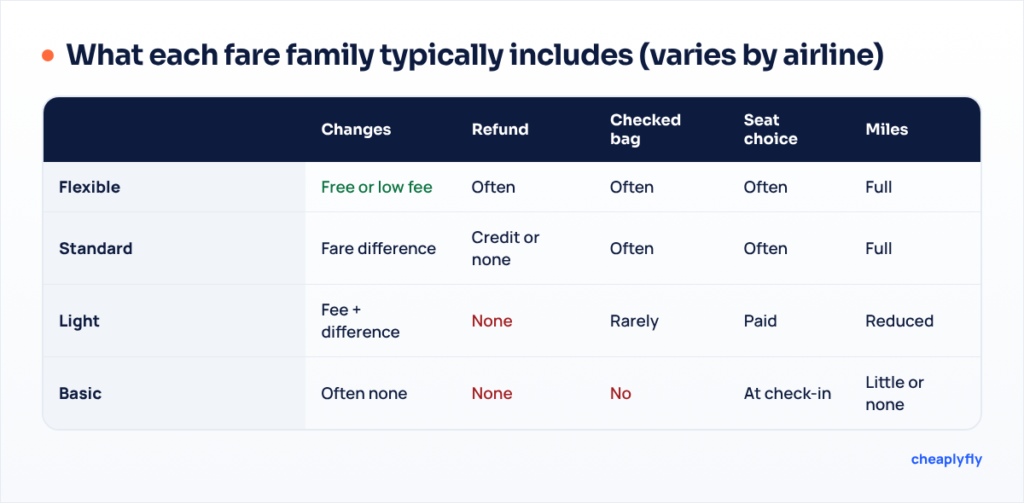
Fare families differ by airline, but they tend to follow the same pattern. Reading from the most flexible fare down to the cheapest, each rung typically takes something away. Use the ladder below to decide where you can safely step down and where you should stop.
- Rung 1: Flexible fare
The most expensive fare in the cabin. Changes are usually free or low cost, and refunds are possible, sometimes with a fee. Seat selection and checked bags are commonly included, and loyalty earning is at its highest. You pay mainly for the right to change your mind.
- Rung 2: Standard or Plus fare
The first thing to go is usually the refund: you may get only a credit or nothing back if you cancel. Changes are allowed but you pay the fare difference and sometimes a fee. Seats and a checked bag are often still included on full-service airlines.
- Rung 3: Light or Saver fare
Checked baggage typically disappears, leaving carry-on only. Free advance seat choice often goes too; you get a seat at check-in or pay to choose. Changes become more expensive or limited, and miles earning may be reduced.
- Rung 4: Basic fare
The lowest price with the tightest rules. Changes and refunds are often not allowed at all after any initial cancellation window. Seats are assigned at check-in, groups may not sit together, and some airlines exclude upgrades and loyalty earning. Some basic fares on short-haul routes also limit carry-on bags.
Delta’s published rules for its Main Basic fare are a clear real-world example of rung 4. As of Oct 2026, Delta says seats are not assigned until after check-in, traveling companions are not guaranteed seats together, changes or refunds are not allowed after the risk-free cancellation period, and the fare does not earn SkyMiles. Other airlines draw the lines in different places, so always check the specific fare.
How to tell which rung you are looking at
Airlines rarely use the same names, so judge a fare by what it includes rather than what it is called. A “Classic” on one airline can match a “Standard” on another.
Five questions to ask of any fare
- Can I change the date, and what will it cost beyond the fare difference?
- If I cancel, do I get money back, a credit, or nothing?
- Is a checked bag included, and what size of carry-on is allowed?
- Can I choose a seat in advance without paying?
- Does the fare earn miles or points, and at what rate?
Low-cost airlines often skip fare families and sell a bare fare with paid extras, or offer two or three bundles. Our guide to what low-cost airlines include shows how those bundles compare with full-service fares.
Is stepping down the ladder worth it?
The cheapest fare is only cheaper if you would not have paid for what it removes. Adding a bag and a seat to a basic fare can bring it close to, or above, the next fare up. The guide to the true cost of a cheap fare walks through that comparison item by item.
Worked example (illustrative)
Imagine an economy route with three fares: Basic at USD 180, Standard at USD 230 and Flex at USD 340. A traveler who needs one checked bag and a chosen seat would add perhaps USD 60 to Basic, making it USD 240, slightly more than Standard, which includes both. The Flex fare only makes sense if a date change is likely. These prices are invented to show the method; real fares and fees vary widely.
When flexibility pays for itself
Choose a higher rung when plans are uncertain, when the trip is booked far ahead, or when a change would be costly, such as travel tied to an event. Choose a lower rung when dates are fixed, you travel light, and losing the fare would be annoying rather than serious.
Myth: A better fare family means a better seat or meal.
Fact: Within the same cabin, the aircraft seat and onboard service are usually the same. Fare families mainly change the rules and extras, not the cabin product.
Myth: A non-refundable ticket means you get nothing back.
Fact: Some charges may still be refundable. Lufthansa’s cancellation and refund page, for example, says that for non-refundable fares, only taxes and fees can be refunded. Rules differ by airline and country, so check your fare conditions.
Myth: The letter Y always means the cheapest economy fare.
Fact: Y is commonly used for full-fare, flexible economy, which is often the most expensive economy booking class.
Refunds, changes and miles: where fare rules meet your rights
Fare rules set what you can do voluntarily. Separate laws can override them in some situations, for example when the airline cancels the flight or when a regulator requires a short cancellation window after booking. Our guide to flight refunds and the 24-hour rule explains where those protections apply.
Miles are the other quiet difference. Loyalty programs often credit a percentage of the distance or price depending on the booking class, and basic fares may earn little or nothing. If you collect miles, read the program’s earning chart alongside the fare, and see points and miles basics for how to value them.
When you compare flights on Cheaplyfly, check the fare name and its conditions on the airline or travel agency page before paying. With the fare classes explained here, you can search your route and judge which rung of the ladder fits the trip.
Frequently asked questions
What is the difference between fare class and cabin class?
Cabin class is where you sit and the service level. Fare class, or booking class, is the price-and-rules bucket inside that cabin. Many fare classes can exist in one cabin.
Where can I find my booking class letter?
It usually appears in the booking confirmation or e-ticket receipt next to each flight, often labeled “class” or “booking class”. The fare basis code, if shown, starts with the same letter in most cases.
Do fare classes mean the same thing on every airline?
No. Apart from common conventions such as Y for full-fare economy and J for full-fare business, each airline assigns letters its own way.
Is a basic fare worth booking?
It can be, if your dates are fixed, you travel with a small bag and you do not need a chosen seat. Add up the extras you would buy before deciding.
Can I upgrade from a basic fare later?
Some airlines allow paid upgrades or fare changes from basic fares and some do not. Check the fare conditions before booking if you think you might want to move up.
Does Cheaplyfly decide the fare rules?
No. Cheaplyfly helps you compare flights. The airline or travel agency you book with sets and applies the fare rules.