How Long Should a Layover Be? Planning Connections That Work
Minimum connection time is the shortest connection an airline will sell, not a comfortable target. Here is how much time to leave for each type of connection.
How long should a layover be? Long enough to cover the walk, the checks and a realistic delay on the first flight, and no longer than the trip can afford. This guide explains the airline minimum connection time, then gives a practical planner for every common type of connection so you can judge an itinerary before you book it.
Key takeaways
- The minimum connection time (MCT) is the shortest connection an airline or airport will sell, not a comfortable target.
- Immigration, a terminal change, rechecking bags or a second security check each add time, and they stack.
- On a single ticket a missed connection is usually the airline’s problem; on separate tickets it is yours, so leave far more time.
- Your first flight’s on-time record and the time of day matter as much as the minutes printed on the itinerary.
- A long layover can be the cheaper, calmer option, especially on long-haul trips with tight onward connections.
What minimum connection time (MCT) really means
Every airport publishes minimum connection times, and airlines can file their own for specific terminals and flight pairs. The MCT is the shortest gap between an arriving and a departing flight that the airline will accept on one booking. Booking systems will not normally sell a single-ticket connection shorter than that figure.
The key word is minimum. An MCT assumes the inbound flight lands on time, the aircraft parks at a normal gate, and you walk straight to the next one. It is designed around the typical passenger on a normal day, not around a family with a stroller or a traveler who needs wheelchair assistance.
MCTs also differ by connection type. The same airport may have one figure for domestic to domestic, another for international to domestic, and another again when the connection crosses terminals. That is why two itineraries through the same hub can show very different layovers and both be “legal”.
- Minimum connection time (MCT)
- The shortest connection an airline will sell on one ticket at a given airport and connection type.
- Protected connection
- Both flights are on the same booking, so the airline that issued the ticket is responsible for getting you to your destination if the first flight is late.
- Self-transfer
- Separate tickets that you combine yourself. Nobody is responsible for the connection except you.
- Airside transfer
- You stay inside the secure zone and walk to the next gate without passing through immigration or collecting bags.
- First port of entry
- The first airport in a country where you clear immigration and customs, even when you are only connecting onward.
How long should a layover be? A connection-time planner
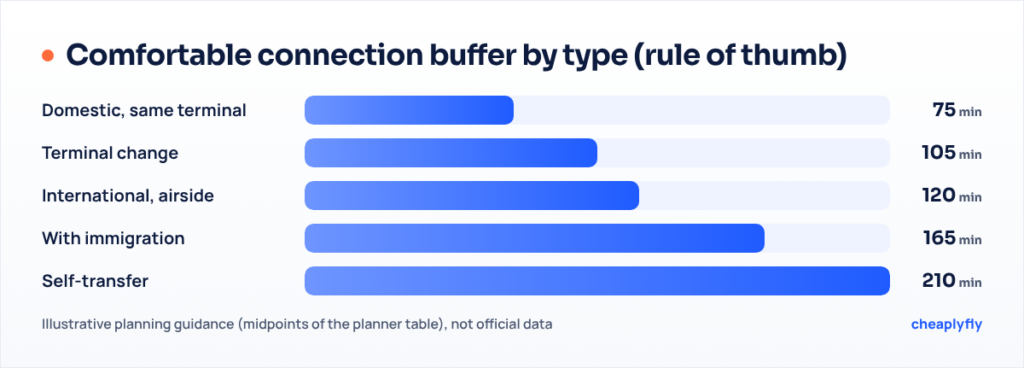
The table below is a planning rule of thumb by connection type. It is not an official standard and does not replace the airline’s own MCT. Use it to decide whether a connection the booking system offers is one you would actually be comfortable with.
| Connection type | What happens on the ground | Comfortable buffer (rule of thumb) | Watch for |
|---|---|---|---|
| Domestic to domestic, same terminal | Walk from gate to gate, no extra checks | About 60–90 minutes | Late inbound flights at busy hubs, remote stands with bus transfers |
| Domestic or regional, terminal change | Train, bus or long walk; sometimes a second security check | About 90–120 minutes | Separate security lanes per terminal, early gate closing |
| International, airside transfer | Transfer security, possibly a passport check between zones | About 90–150 minutes | Zone changes, such as moving into a passport-free travel area |
| International with immigration | Immigration, customs, often rechecking bags and security again | About 2.5–3 hours or more | Peak arrival waves, long immigration lines, bag recheck |
| Self-transfer on separate tickets | Possibly immigration, collect bags, check in again, security | 3–4 hours minimum, more for long-haul | Check-in deadlines, no protection if you miss the flight |
Two adjustments apply to every row. Add time if your first flight often runs late or arrives in an evening bank of flights, and add time if anyone in your group moves slowly. Subtract time only if you know the airport well, travel with carry-on only, and the first flight has a strong on-time record.
Five things that quietly stretch a connection
The clock on an itinerary counts from scheduled arrival to scheduled departure. The time you really have is shorter, because several steps eat into it before you reach the next gate.
1. Taxi, parking and deplaning
The scheduled arrival time is when the aircraft reaches the gate, but a remote stand, a bus to the terminal, or sitting near the back of a wide-body aircraft can add a meaningful chunk before you even reach the corridor.
2. Immigration at the first port of entry
Some countries require every international arrival to pass through immigration and customs at the first airport, even when the passenger is connecting. The United States is the best-known example: US Customs and Border Protection explains that processing must be completed at the first port of entry, after which travelers continue to their connecting flight. The same idea applies when you enter the Schengen area: the passport check usually happens at the first Schengen airport, not the final one.
3. Rechecking bags
Where you clear customs at the first port of entry, you may have to collect checked bags, take them through customs and drop them again for the next flight. Some routes now avoid this; CBP describes remote baggage screening and preclearance at selected foreign airports, which moves the inspection to before departure. Ask the airline whether your bags are checked through.
4. A second security screening
Many hubs rescreen transfer passengers, particularly when arriving from outside a region with matching security standards. That line can be short at midday and long during a morning arrival wave.
5. Boarding closes before departure
The departure time on your ticket is when the doors close and the aircraft pushes back. Boarding often ends well before that, and the gate may be the farthest one in the terminal. Treat the real deadline as the boarding cutoff, not the departure time.
Single ticket versus separate tickets
Whether a connection is protected changes how much risk a short layover carries. On one booking, if the first flight is late and you miss the second, the airline that sold the ticket normally rebooks you on the next available service at no extra cost. Our guide on what to do after a missed connection walks through those next steps and what you can ask for.
On separate tickets, the second airline has no obligation to wait or rebook. If you miss the flight, you may lose that fare and pay for a new one, and checked bags may need to be collected and checked in again. That is why the planner suggests at least three to four hours for a self-transfer. Before choosing one, read the full picture on self-transfer flights and what can go wrong.
Short protected connection
- Less total travel time and less waiting
- The airline rebooks you if the first flight is late
- Bags are usually checked through
What it can cost you
- A missed connection can mean hours or a night at the hub
- Bags may miss the tight connection even when you make it
- Little slack for immigration lines or a gate change
How to judge a connection before you book
When you compare itineraries on Cheaplyfly flight search, the layover length is shown for each option. A few extra checks turn that number into a real decision.
- If the itinerary changes airports
Then treat it as a self-transfer even within one city. Moving between two airports needs ground transport time and usually a fresh security check.
- If you need to enter the country to connect
Then check whether you need a visa or electronic authorization just to transit. Our travel documents checklist covers transit rules and the main authorization schemes.
- If the first flight is the last one of the day
Then a delay is more likely to push you into an overnight stay. Prefer a longer connection or an earlier first flight.
- If you are traveling with children or need assistance
Then add at least 30–60 minutes to the planner and request assistance when you book, not at the airport.
- If the connection is on one ticket and close to the minimum
Then it is still a valid booking, but carry essentials in your cabin bag in case the checked bag misses the flight.
Look at the terminal codes in the flight details. Arriving and departing from the same terminal is usually the single biggest time-saver on a tight connection.
When a long layover is the smarter choice
A longer stop is not always wasted time. On a long-haul journey, three to five hours at a well-equipped hub can mean a proper meal, a shower or lounge access, and a much lower chance of a missed connection. Some long layovers also come with a noticeably lower fare, because fewer travelers choose them.
Very long layovers, roughly eight hours or more, start to raise different questions. Can you leave the airport legally with your passport? Do you need a hotel or a transit hotel? Will you be awake at odd hours ahead of another long flight? If you are planning a long stopover between two long flights, our guide to long-haul flights, sleep and jet lag has tips for timing rest around the connection.
Worked example
Illustrative only. A traveler compares two one-ticket itineraries to the same destination. Option A has a 70-minute connection that requires immigration and a bag recheck at the first port of entry. Option B costs slightly more and has a 3-hour connection at the same airport. Using the planner, international connections with immigration call for roughly 2.5–3 hours. Option A is sellable but tight: one long immigration line could cause a missed flight and a rebooking, possibly the next day. Option B fits the planner, and the extra cost buys a far more predictable arrival.
What to do if the first flight is running late
Tell the cabin crew as soon as you know the connection is at risk. They can sometimes arrange to have you seated near the front or pass details to the ground team. Check the airline app, which may already show an automatic rebooking.
When you land, follow the transfer signs rather than the arrivals exit unless you must clear immigration. If you miss the flight on a single ticket, go to the transfer desk or use the app rather than buying a new ticket. If you are on separate tickets, contact the second airline right away, because some offer a paid change that is cheaper than a new fare.
Frequently asked questions
Is a 1-hour layover enough?
It can be for a domestic connection in the same terminal on one ticket. For an international connection that involves immigration, customs or a terminal change, one hour is usually tight, even if the booking system offers it.
Who decides the minimum connection time?
Airports publish standard minimum connection times, and airlines can file their own for specific terminals and flight combinations. Booking systems use these figures to decide which single-ticket connections can be sold.
Will the airline wait for me if my first flight is late?
Usually not for one passenger. On a single ticket, the airline normally rebooks you instead. On separate tickets, the second airline has no duty to wait or rebook.
Do my bags transfer automatically?
On one ticket they are normally checked through to the final destination, but some countries require you to collect them at the first port of entry for customs. On separate tickets you usually collect and recheck them yourself.
How long should a layover be for a self-transfer?
Plan at least three to four hours, and more when the first flight is long-haul or you have checked bags. Remember that check-in for the second flight may close well before departure.
Can I leave the airport during a long layover?
Only if your passport and the local entry rules allow it. Check visa and transit requirements for that country before you book, and leave enough time to return through security.